

The best time to prune a peach tree is late winter to early spring, after the hardest cold has passed and around the time flower buds begin to swell. The exact month shifts from region to region, so bud stage is a safer guide than a calendar date.
Key Takeaways
- Peach trees are pruned in late winter to early spring, after the hardest cold has passed. Texas guidance sets February, just before March bloom, while Maryland guidance runs from bud swell through petal fall.
- Fall and early-winter pruning is the window to avoid. Research from the Alabama Cooperative Extension System links it to early tree death in Southeast peach trees.
- Summer pruning stays light. July cuts can help a vigorous tree, but every cut removes some of next year’s fruiting wood, and August pruning is not advised on trees still carrying fruit.
When should a peach tree be pruned?
Peach trees are best pruned in late winter to early spring, after the hardest cold has passed and while the flower buds are swelling. The exact month shifts with region: February in warm regions, March or April in colder ones.
Bud stage, not the calendar date, sets the window. A warm winter brings bloom earlier, and the pruning window moves up with it. Growers with only a few trees can wait until pink bud (the stage when flower buds show color just before they open).
The window has two edges. It opens when the hardest cold ends and closes at petal fall, after which only summer work remains.
If the buds are swelling and no hard freeze is forecast, start cutting. If the buds are still tight and a freeze is possible, wait, because the Southeast research behind this advice favors pruning as late in the window as possible.
Peach tree pruning calendar at a glance
A peach tree has three pruning windows, one season to skip, and one exception: dead or diseased wood can come out whenever it appears.
| Window | What to do | Watch-out |
|---|---|---|
| Late winter, after the hardest cold | Main pruning: thin crowded branches and open the center | A hard freeze soon after cutting can damage buds |
| Bud swell through bloom | Finish main pruning and remove weak fruiting wood | Open blooms are more cold-sensitive than closed buds |
| Summer, July or right after harvest | Remove vigorous upright shoots only | Each cut removes next year’s fruiting wood |
| Fall to early winter | Avoid pruning | Linked to early tree death in the Southeast |
| Any time | Cut out dead, diseased or broken wood | Choose dry weather |
Dormant-season pruning (done while the tree is leafless and resting) does the structural work, while summer pruning only trims excess growth. The split follows how peaches fruit: on the previous year’s wood, so a July cut trades part of next year’s crop for light and shape.

Why do peach trees need their own pruning window?
Peach trees are pruned late because cutting stimulates the tree, and a stimulated tree is more likely to lose buds to cold. Peaches also bloom earlier than apples and pears, so their flowers meet spring frost more often.
The Alabama Cooperative Extension System reports that delaying pruning until pink bud reduced winter kill of fruit buds and pushed flowering back by two to four days. Its research also tied fall and early-winter pruning to early tree death in Southeast peach trees.
Wounds add a second risk. Canker (a diseased, sunken patch of bark) enters stone fruit trees through bark injuries and pruning cuts, and a tree that is still dormant cannot defend a fresh wound. That is why Mid-Atlantic guidance runs from bud swell, when growth resumes, through petal fall.
Three checks settle most timing decisions:
- Has the hardest cold of winter passed? If not, wait.
- Are the buds swelling or showing pink? If so, the window is open; if they are still tight, there is no rush.
- Is dry weather ahead? Make cuts in dry weather, ideally with about three dry days in the forecast.
Cold hardiness is a peach tree’s ability to survive winter cold, and mistimed pruning can lower it in two ways. Cuts made too early raise the risk of bud injury. Late-summer or early-fall cuts raise the risk of frost crack, a bark split usually on the south or west side of the trunk.
When should a peach tree be pruned in your region?
Timing runs from February in the warm South to March or April in the Mid-Atlantic and colder regions, and bud stage should confirm the date locally. Texas A&M AgriLife Extension puts Texas pruning at February, just before March bloom, with late spring frost as the region’s main risk.
| Region | Pruning window | Cue or caveat |
|---|---|---|
| Texas | By February, just before March bloom | Late spring frost is the main risk |
| Southeast (Alabama research) | February to March, depending on location | Delay as long as possible |
| Eastern North Carolina | Early February to early March | Moves earlier when bloom comes early |
| Maryland | Bud swell through petal fall | Canker enters late-winter cuts |
| Delaware (2010 guidance) | March to April, including bloom | Earlier cuts raised bud cold-injury risk |
| Pennsylvania | Late winter | Fall and early-winter cuts risk winter injury and canker |
| Michigan | Early spring | Avoid fall and winter because of canker |
| California (Sacramento area) | Late February to early March | Late-dormant wounds heal faster |
| Pacific Northwest | Late winter, before bud break, in dry weather | Summer is favored for stone fruit where winters are wet |
The sources behind this article do not cover Alaska, Hawaii, the US territories, the Mountain West, the Great Plains or the Desert Southwest. In those areas, a county extension office is the best check.
Hardiness zone numbers do not set the date by themselves: no extension source reviewed ties a zone, including zone 7, to a month. A gardener in zone 7 should use the nearest row above and confirm with bud stage.
Can a peach tree be pruned in summer?
Yes, a peach tree can be pruned lightly in summer, usually in July or right after harvest. Summer cuts remove vigorous upright shoots, but each cut also removes wood that would bear fruit next year, so heavy summer pruning should be avoided.
Summer pruning exists to control vigor and let light in. Removing vigorous upright shoots (fast-growing shoots that point straight up) opens the canopy.
A leaf bud needs roughly 30 percent direct sunlight to turn into a flower bud for the following year. In Texas, cuts made right after harvest also help keep top growth in check.
University of Delaware Extension (2010 guidance) calls July pruning useful on vigorous trees, advises against August cuts on trees still in fruit, and avoids mid-May through June.
Heavy summer pruning is the costliest mistake here, since each shoot removed is fruiting wood lost for next year. If fruit is still on the tree, wait until harvest and take only the shoots that block light.
What if the buds have already opened or the tree has fruit?
A peach tree can still be pruned in bloom, but once fruit sets, only dead wood and a few shoots should come out until harvest. The right move depends on the stage:
- Buds swollen or showing pink: Prune now if no hard freeze is forecast.
- Tree in bloom: Pruning is acceptable through April in the Mid-Atlantic, and open flowers make it easier to judge how much fruiting wood to thin.
- Fruit on the branches: Cut out dead, diseased or broken wood as soon as it is seen, and leave other work until after harvest.
- Window missed entirely: Use the light summer window after harvest, or wait for next late winter. Skip fall.
The upper branches are the ones most likely to hold surviving fruit after a late freeze, so cutting the top can wait until that risk has passed.
When does a new peach tree get its first pruning?
Whether you purchase a sapling from a nursery or choose to grow a peach tree from seed, a newly planted peach tree is first pruned at planting. An unbranched whip is cut back to about twenty-six to thirty inches.
A branched tree loses any limbs lower than eighteen inches, and the kept scaffold branches are cut back by half.
- At planting, cut an unbranched whip (a young tree with no side branches) back to 26 to 30 inches.
- On a tree that already has side branches, choose three or four scaffold branches (the main structural limbs), starting about 18 inches above the ground and spaced around the trunk.
- Cut those scaffold branches back by half, and remove every branch lower than 18 inches.
- In the first spring after planting, remove broken or diseased branches and vigorous upright shoots growing inside the main scaffolds.
- In the second spring, pick two or three side limbs on each scaffold, spaced 6 to 8 inches apart, and shorten them by half.
Extension guidance does not count months from planting; it ties each cut to the planting day and the next two spring windows. After two years of training, light corrective cuts keep the open center (a vase shape with no branches in the middle).
What about dwarf and small trees?
Genetic dwarf peach trees follow the same timing as standard trees; no extension source reviewed gives them a separate window. Their pruning is lighter, mainly thinning branches to open the canopy and cutting back to hold height.
Mature height varies widely by variety, from about 4 to 6 feet in some to 8 to 10 feet in others.
What mistakes should be avoided when pruning a peach tree?
The costliest peach pruning mistake is cutting at the wrong time: in fall, in early winter, or just ahead of a hard freeze. Five more are worth avoiding:
- Pruning in wet weather. Rain gives disease an easy way into fresh cuts, so wait for dry conditions.
- Alternating heavy and skipped years. Texas guidance warns that alternate-year pruning causes excessive growth after a heavy cut, so annual, moderate pruning controls vigor better.
- Leaving stubs or sealing cuts with paint. Clean cuts that leave no stubs matter more than any dressing, and pruning paint is not needed.
- Letting the center fill in. An open center lets air and light reach the canopy, which reduces brown rot on the fruit.
- Cutting off the wrong wood. Peaches fruit on the previous year’s growth, so strong one-year-old shoots are the wood to keep.
How much can be cut off at once?
Texas peach guidance puts annual removal at about 40 percent of the tree, which stimulates strong new fruiting wood. Other extension guidance describes thinning one-third to half of the one-year-old fruiting branches.
Because a heavy cut in one year causes excessive regrowth the next, moderate cuts every year are the safer pattern. Large cuts also trigger water sprouts (fast, upright shoots) below the cut, and those should be pulled or cut at their base as they appear.
Should the top of the tree be trimmed?
Yes, because an untrimmed peach tree pushes its fruit higher each year until the crop is out of reach. In Texas orchards, shoots above 7 feet come out except the red fruiting shoots, which keeps the fruiting zone low enough to harvest from the ground.
An overgrown tree should come down gradually, by about one-third a year over three years, because old stone fruit trees may not resprout after one drastic cut.

What tools and safety rules apply?
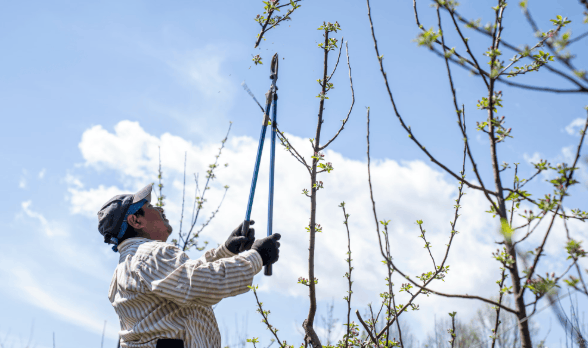
Check for power lines before anything else. Keep people, ladders and tools at least 10 feet away, and hire an insured ISA Certified Arborist if the tree is within that distance, as Purdue Extension advises.
- Look up before moving a ladder or long-handled pruner, and read the ladder’s safety label.
- Use sharp bypass pruners, loppers or a pruning saw matched to the branch. Wood that is too thick for the tool damages the plant and the tool, and published size limits differ, so follow the tool’s label.
- Stand clear of the drop zone when using a pole pruner, since falling branches can hit the operator.
- Hire a professional for branches that cannot be reached safely from the ground.
- On a diseased tree, University of Maryland Extension advises cleaning tools between cuts with 70 percent alcohol, or bleach diluted one part to nine parts water. Rinse bleach off afterward, since it corrodes metal.
Conclusion
Let bud stage, not the calendar, decide: prune after the hardest cold has passed, once buds are swelling and dry weather is ahead, and keep summer cuts light. Skip fall pruning, work on dead or diseased wood whenever it appears, and use the regional table to adjust for location.
FAQ
Is there a best time of day to prune a peach tree?
No extension publication reviewed for this article names a best hour of the day. The nearest verified rule concerns weather: make cuts in dry weather, ideally with about three dry days in the forecast, because wet conditions help disease reach fresh wounds.
Does a peach tree need water or fertilizer after pruning?
Heavy dormant pruning has the same effect on fruit trees as applying nitrogen, so fertilizer should be reduced or skipped after a heavy prune, according to University of Illinois Extension. Manure supplies nitrogen, so the same caution applies to it. Watering follows soil moisture rather than the pruning date, and peaches are most drought-sensitive at final swell, when the fruit grows quickly.
How should pruned wood and leaves be disposed of?
Dead and diseased wood should be removed from the tree and the orchard and burned, buried or otherwise disposed of promptly. Diseased leaves, shoots and fruit on the tree and ground should go too, along with fruit mummies (dried, shriveled fruit left hanging). Burning and yard-waste rules differ by city and county, so a local fire or waste authority sets the allowed method.
How can you tell whether pruning helped?
Strong new shoots the following season are the clearest sign. Benchmarks for good fruiting shoots run from about 12 to 18 inches in Maryland to 18 to 24 inches in Texas, so local extension guidance sets the target. An open canopy matters too, since a leaf bud needs roughly 30 percent direct sunlight to become a flower bud.
Can dead or diseased branches be cut at any time of year?
Yes. Dead, diseased or broken wood can be removed as soon as it is seen, in any season, preferably in dry weather. Prompt removal also keeps the wood from becoming a source of new infection.
Pruning windows and disposal rules vary by region and local ordinance, so a county extension office takes precedence. Trees near power lines or out of reach from the ground call for a certified arborist.