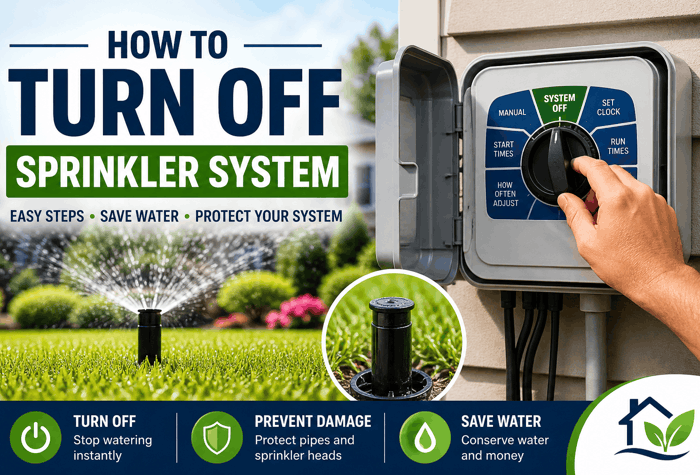


Different types of sprinkler systems for lawns and gardens fall into three groups: hose-end sprinklers that connect to an outdoor spigot, in-ground systems with buried pipe and pop-up heads, and drip systems that release water slowly at plant roots.
Each group differs in coverage area, water pressure needs, and how fast it applies water.
Key Takeaway
- Sprinklers are usually the best choice for turf, while drip irrigation suits shrubs, trees, and gardens, according to University of Georgia Extension.
- Rotary sprinklers apply 0.2 to 0.5 inches of water per hour, while spray heads apply 1 to 2 inches, according to University of Georgia Extension.
- Colorado State University Extension advises against mixing sprinkler types in one zone, because each type delivers water at a different rate.
- Calling 811 is free and comes before digging for a sprinkler system. Waiting periods vary by state, and Texas811 states two business days.
What are the different types of sprinklers?
University of Georgia Extension names two basic types of home irrigation: sprinkler and drip. Sprinklers split again into hose-end models that move between spots and in-ground systems that stay buried and run on automatic controls.
Hose-end sprinklers are the simplest type: a head on a garden hose, set out where water is needed. In-ground systems group buried heads into zones, meaning sets of heads that one valve controls. Drip systems use emitters, small devices that release water a drop at a time.
| Type | How It Works | Best Suited To |
|---|---|---|
| Hose-End Sprinkler | Connects to a garden hose and sprays water over the surface. | Lawns, small gardens, trees, and shrubs |
| In-Ground Sprinkler System | Uses buried pipes to supply pop-up sprinkler heads arranged in watering zones. | Large lawns and established turf areas |
| Drip Irrigation System | Delivers water slowly through emitters placed near individual plants. | Shrubs, trees, flower beds, and vegetable gardens |
In-ground systems are limited by the water the supply can deliver. University of Georgia Extension divides the yard into zones, so every head in a zone runs at once. Its example: with 12 gallons per minute available and heads using 2.5 gallons per minute each, a zone holds at most four heads.
What is the most commonly used sprinkler system?
University of Georgia Extension names rotary and spray heads as the most common lawn and garden sprinklers. Iowa State University Extension and Outreach calls the oscillating sprinkler the most common portable type.
No source reviewed reports how many homes use hose-end versus in-ground systems, so no ownership share is given. UC Marin Master Gardeners adds that overhead spraying is a much less efficient way of putting water where roots can use it.

What are the types of hose-end sprinklers?
Iowa State University Extension and Outreach lists five types of portable sprinklers: oscillating, impulse, fixed, traveling, and sprinkler hose. Oscillating models are the most commonly used, and each type makes its own spray pattern.
According to Iowa State:
- Oscillating: A horizontal tube with several outlets turns back and forth, watering a rectangular pattern across medium-sized areas. Water lands more heavily at the outer edge.
- Impulse: A water stream strikes a pin or hammer, breaks into droplets, and turns the head through a full or partial circle. Water lands more heavily near the center, with considerable force.
- Fixed: The head never moves and waters one pattern, such as a circle, semicircle, square, or rectangle. Fixed sprinklers generally suit small areas.
- Traveling: The unit creeps across the lawn along a cable or cord on a predetermined path. Traveling sprinklers are generally used on lawns.
- Sprinkler hose: A plastic hose releases water from tiny round holes along its length and reaches irregular areas, but distribution is hard to predict.
Hose-end sprinklers share three drawbacks. They spray water high, where some evaporates, they wet foliage, which can encourage disease, and they wet the whole soil surface, which promotes weeds. Iowa State recommends low-spraying models run in the cooler part of the day to limit evaporation.
UC Marin Master Gardeners adds that they suit seed beds, but a soaker hose or drip line works better as plants grow. A catch-can test shows how evenly any hose-end sprinkler waters. The steps follow Iowa State and UC Marin Master Gardeners:
- Place several small, straight-sided cans, such as empty tuna cans, at different spots within the spray pattern.
- Connect the sprinkler to the same hose length and size normally used, and turn the water on to normal pressure.
- Run the sprinkler for a set period, such as 15 minutes.
- Measure the water depth in each can. Cans holding more water mark spots that are over-sprayed.
- Overlap the patterns or adjust the nozzle until the depths run close to even.
What are the types of in-ground sprinkler heads?
In-ground systems mainly use spray heads and rotary heads, also called rotors. Spray heads suit small, narrow, or irregular lawn areas, while rotors suit large, open turf and apply water much more slowly.
Both kinds come as pop-up heads, which sit flush with the soil and rise when water pressure arrives. University of Georgia Extension recommends mounting heads on a swing joint or flexible riser, a fitting that protects the buried pipe if equipment rolls over it.
The table gives pressure in pounds per square inch (psi).
| Head type | Source | Operating pressure | Radius or throw | Application rate |
|---|---|---|---|---|
| Spray head | University of Georgia Extension | 15 to 35 psi | 10 to 20 feet radius | 1 to 2 inches per hour |
| Pop-up spray | Colorado State University Extension | 30 to 40 psi | 10, 12, or 15 feet radius, most common | 1 to 2½ inches per hour |
| Rotary sprinkler | University of Georgia Extension | 30 to 80 psi | 30 to 50 feet radius | 0.2 to 0.5 inches per hour |
| Rotor head | Colorado State University Extension | 40 to 50 psi, typical | 30 feet | ¼ to ¾ inch per hour |
The two sources give different ranges but agree on the pattern: rotors apply water far more slowly than spray heads. Manufacturer specifications for a specific head take precedence. Colorado State calls the slower rate an advantage on clayey or compacted soils.
University of Georgia Extension says the fast spray rate can limit spray heads on heavy soils and steep slopes.
Colorado State University Extension describes three kinds of rotor. Impact heads turn when the stream strikes a spring-loaded arm and clog less in dirty water. Gear-drive heads run quietly.
Stream rotors throw rotating streams at lower application rates, which suits slopes and slow-absorbing soils, though they can plug when water is not filtered.
Different sprinkler types should not share a zone. Colorado State gives the reason: each type delivers water at a different rate. The Los Angeles Department of Water and Power recommends matched precipitation, where every head applies the same depth.
University of Georgia Extension limits square spacing to 55 percent of a head’s wetted diameter in winds up to 3 miles per hour. At 8 to 12 miles per hour, the limit is 45 percent.
While convenient, buried pipes will crack if they freeze. To avoid costly repairs, it helps to know exactly how do you blowout a sprinkler system before the first frost.
If you don’t have an air compressor, you should learn how to winterize a sprinkler system without blowout using simple drain valves instead.
When is drip irrigation better than a sprinkler?
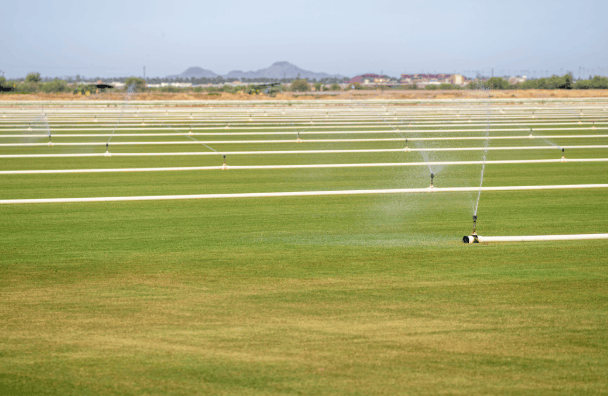
Drip irrigation is better than a sprinkler for individual plants such as shrubs, trees, and vegetable or flower beds. University of Georgia Extension adds that sprinklers are usually the best choice for turf and that drip is not well adapted to solid plantings of grass.
Drip systems apply water frequently and slowly through emitters. University of Georgia Extension gives point-source emitters a fixed flow of one-half to two gallons per hour, with one gallon the most common.
Most are designed for 15 to 20 pounds per square inch, so most systems need an in-line pressure regulator.
UC Marin Master Gardeners says soaker hoses water unevenly and some last only a season or two. UC Marin Master Gardeners gives these rules of thumb for drip layouts:
- Half-inch or five-eighths-inch tubing should not run longer than 400 feet on one valve, also called a zone.
- One zone should not exceed 200 emitters rated at one gallon per hour.
Clogging is a common upkeep issue. University of Georgia Extension says filters may need flushing weekly to twice a month, depending on water quality. Each lateral line’s end should be opened once a year to flush sediment.
The Los Angeles Department of Water and Power says micro sprays clog easily and need monthly checks.
Sources disagree on drip for lawns. University of Georgia Extension says drip is not well adapted to solid plantings of shallow-rooted plants such as grass. UC Marin Master Gardeners says in-line drip tubing can also be used for lawns.
The Los Angeles Department of Water and Power encourages subsurface or drip irrigation and other low-flow water-distribution systems.
How do you choose the right type of sprinkler for a lawn?
Match the sprinkler to the lawn’s size and shape, the home’s water pressure, and the soil. Spray heads suit small or irregular areas, rotors suit large open turf, and slow-absorbing clay soil calls for the lower application rate of rotors.
University of Georgia Extension supplies most of these matches:
- Small, narrow, or irregular turf: Spray heads.
- Large, open turf: Rotary heads, often the most economical choice.
- Heavy soil or steep slopes: Slower-applying rotors, because fast spray rates can limit spray heads there.
- Small spots with a hose: Fixed sprinklers. Medium rectangles: oscillating models.
- Shrubs, trees, and garden beds: Drip emitters.
Colorado State University Extension says water distribution patterns change with pressure and that the pressure recommended for the specific sprinkler head should be used.
University of Georgia Extension says static pressure in a city main, meaning pressure with no water flowing, ranges from 30 pounds per square inch to well over 100. A gauge on an outside faucet, read at several times of day, shows the lowest pressure.
EPA WaterSense says labeled spray sprinkler bodies regulate pressure at the nozzle and can help a typical home with an irrigation system operating at 60 psi or higher save as much as 5,600 gallons of water per year.
Soil sets the limit on application rate. Water applied faster than the soil absorbs it for extended periods causes puddling and runoff, according to University of Georgia Extension, which gives these intake rates:
| Soil texture | Intake rate in inches per hour |
|---|---|
| Sandy; loamy sand | 2.0 to 3.5 |
| Sandy loam; loam | 1.5 to 2.5 |
| Silt loam; clay loam | 0.5 to 1.5 |
| Sandy clay; clay | 0.2 to 0.5 |
Figures run somewhat higher with grass cover.
A sprinkler’s application rate in inches per hour equals 96.3 times its gallons per minute, divided by the spacing between sprinklers times the spacing between rows, according to University of Georgia Extension.
In a generic example with round numbers, 2 gallons per minute at 15-foot spacing both ways works out to about 0.86 inches per hour.
By that example, 0.86 inches per hour falls below the intake rate of sandy loam and loam but above that of clay. When the rate runs well above intake, University of Georgia Extension advises a smaller nozzle, or a larger wetted diameter at wider spacing.

What should be checked before installing an in-ground sprinkler system?
Before installing an in-ground sprinkler system, contact the 811 call-before-you-dig line so buried utility lines get marked. Then check local and state plumbing codes, because most require a backflow device where a permanent irrigation system connects to a city water supply.
Five checks come before any digging:
- Contact 811 before any digging starts. The call is free, and Texas811 states that Texas law requires it two business days ahead, even in a home backyard. MISS DIG 811 states at least three business days, so waiting periods differ by state.
- Let the utility owners mark their lines. MISS DIG 811 says member utilities mark the locations of underground utilities after an 811 request.
- Confirm the call was made when hiring out the work.
- Check state and local plumbing codes for backflow prevention. Backflow means contaminated irrigation water flowing back into the main water supply. University of Georgia Extension says most codes require at least a double-check valve where a permanent system connects to a municipal supply. Some require a reduced pressure device where chemicals are injected.
- Take design questions beyond the basics to the county Extension office or a local irrigation dealer, which University of Georgia Extension names for that purpose.
Texas811 notes that digging without locating underground utilities can damage lines and create safety risks. No source reviewed sets a project size at which a licensed installer becomes mandatory, so that depends on state and local rules.
Choosing between sprinkler types
The right type of sprinkler follows from three measurable facts: the area’s size and shape, the home’s water pressure, and the soil’s intake rate. Sprinklers suit turf, drip suits plants, and in-ground systems need an 811 call and a code check first. Matching the head’s application rate to the soil helps prevent runoff.
FAQs
How many types of sprinklers are there?
No standard count exists. University of Georgia Extension names two basic types of home irrigation, sprinkler and drip, and Iowa State University Extension and Outreach lists five portable sprinklers.
Can different sprinkler types share one zone?
No. Colorado State University Extension advises against mixing sprinkler types in one zone, because each type delivers water at a different rate. Spray heads and rotors differ widely in application rate.
Is drip irrigation suitable for lawns?
Sources differ. University of Georgia Extension says drip is not well adapted to solid plantings of grass, while UC Marin Master Gardeners says in-line drip tubing can also be used for lawns. Sprinklers remain the usual choice for turf.
Is a call to 811 required before installing a sprinkler system?
Yes. Call 811 before digging; state law sets the waiting period. Texas811 states two business days in Texas, and MISS DIG 811 states three business days. The call is free.
What water pressure do sprinklers need?
It depends on the head. University of Georgia Extension gives spray heads 15 to 35 pounds per square inch and rotary heads 30 to 80. Oklahoma State University Extension says pressure above the manufacturer’s range causes misting.
Which sprinkler type suits a small lawn?
Spray heads or fixed sprinklers. University of Georgia Extension says spray heads are most often used in small, narrow, and irregular turf areas. Iowa State University Extension and Outreach says fixed sprinklers generally water small areas.
Disclaimer: Local plumbing codes and water pressure vary; always consult a licensed professional and verify utility lines via 811 prior to installation.