
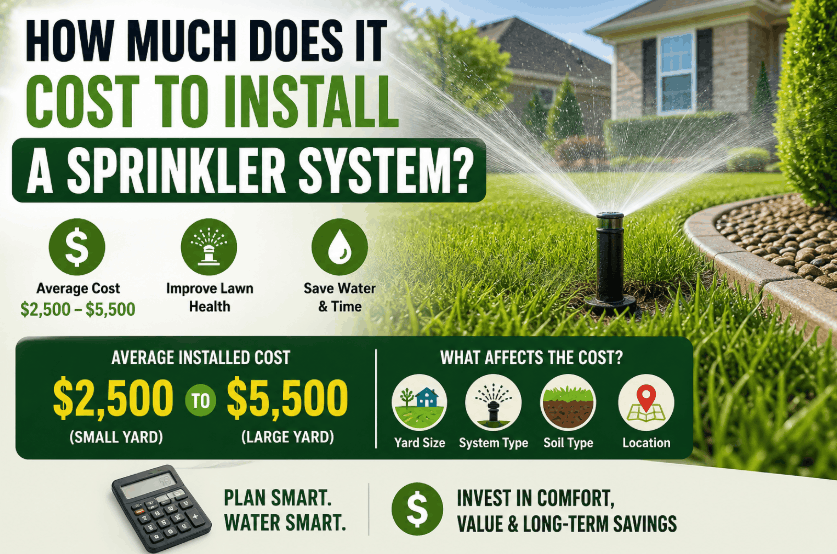
The cost to install a sprinkler system typically runs $2,500 to $6,500 for a standard quarter-acre lot, or about $0.90 to $1.70 per square foot of watered lawn. Most yards need five to seven zones at roughly $600 to $1,000 each, and lots of one acre or more run $8,000 to $20,000 or more.
Key takeaways
- An in-ground sprinkler system typically costs $2,500 to $6,500 installed on a quarter-acre lot, and $8,000 to $20,000 or more on a lot of one acre or more.
- Zones set the price: the first zone costs $585 to $1,335, and each extra zone adds about $750.
- Labor is about 60% of a professional quote, at $45 to $100 per hour, and trenching adds $4 to $12 per linear foot.
- Budget extra for a backflow preventer ($100 to $600), a permit ($35 to $200), and a smart controller ($125 to $400).
- Yearly upkeep runs $50 to $150 for winterization in cold climates and $100 to $400 for a typical repair call.
How much does it cost to install a sprinkler system?
A professionally installed in-ground sprinkler system typically costs $2,500 to $6,500 for a standard quarter-acre lot. That works out to about $0.90 to $1.70 per square foot of watered lawn.
For a verified national benchmark, the 2023 NAR/NALP Remodeling Impact Report estimated $6,000 for an irrigation system serving a 5,000-square-foot lawn; actual quotes vary with watered area, zone count, equipment, and local labor and permit requirements.
Three things set the price: how much lawn is watered, how many zones the yard needs, and how automated the system is. Here is what each type of system typically costs once installed:
| System type | Typical installed cost | Best for |
|---|---|---|
| In-ground (underground) sprinklers | $2,500 to $6,500 | Established lawns and a clean look |
| Automatic in-ground (programmed or smart schedules) | $3,000 to $8,000 | Hands-off watering schedules |
| Drip irrigation | $1,190 to $2,900 | Flower beds and gardens |
| Above-ground hose sprinklers (DIY) | $15 to $80 | Small lawns and temporary setups |
| Large lot (one acre or more, in-ground) | $8,000 to $20,000 or more | Big properties |
For planning purposes, the 2023 NAR/NALP report estimated $6,000 for an irrigation system serving a 5,000-square-foot lawn; obtain local written quotes for an actual yard.
The right system type also affects equipment, zoning, and installation time; see the different types of sprinkler systems before comparing quotes.
The 2023 Remodeling Impact Report: Outdoor Features, from the National Association of REALTORS® (NAR) and the National Association of Landscape Professionals (NALP), estimated a typical 5,000-square-foot irrigation installation at $6,000.

How much does a sprinkler system cost for a quarter-acre yard?
A quarter-acre yard typically costs twenty-five hundred to sixty-five hundred dollars for an in-ground system. Half an acre costs roughly forty-four hundred to sixty-five hundred dollars, and a full acre starts near eighty-seven hundred.
A quarter-acre lot is 10,890 square feet, and a basic in-ground system for it starts around $2,200. A fully equipped system with five to seven zones, a backflow preventer, and a smart controller more often lands between $3,000 and $6,500, with averages reported near $4,600.
| Lot size | Square feet | Typical cost, basic in-ground system |
|---|---|---|
| 1/8 acre | 5,445 | $1,090 to $1,635 |
| 1/6 acre | 7,260 | $1,450 to $2,180 |
| 1/5 acre | 8,712 | $1,750 to $2,620 |
| 1/4 acre | 10,890 | $2,180 to $3,270 |
| 1/2 acre | 21,780 | $4,360 to $6,530 |
| 3/4 acre | 32,670 | $6,530 to $9,800 |
| 1 acre | 43,560 | $8,700 to $13,100 |
Watered area, the square footage of lawn and beds the sprinklers actually cover, matters more than lot size. The NALP survey priced 5,000 square feet of lawn on a 14,000-square-foot lot, so measure the grass and beds that will get sprinklers and use that number when asking for quotes.
How many zones does a yard need, and how does that change the price?
Each sprinkler zone costs roughly six hundred to one thousand dollars to install. A typical yard needs five to seven zones, which puts the total between about three thousand and nine thousand dollars.
Water pressure and flow at the spigot may not support watering an entire lawn at once, so the installer splits the yard into zones that run one at a time. The first zone costs $585 to $1,335, and each extra zone adds about $750.
| Number of zones | Typical installed cost |
|---|---|
| 1 | $585 to $1,335 |
| 2 | $1,165 to $2,665 |
| 3 | $1,875 to $5,000 |
| 4 | $2,335 to $5,665 |
| 5 | $3,125 to $8,000 |
| 6 | $3,500 to $8,165 |
| 7 | $4,085 to $9,335 |
Weak water flow means more zones for the same lawn, so measure it before asking for quotes:
- Make sure no water is running inside or outside the house.
- Screw a pressure gauge onto the outdoor faucet nearest the water meter, turn the faucet on, and read the pressure in pounds per square inch (psi). The local water company can also supply the pressure.
- Fill a 5-gallon bucket from a fully open faucet and time it in seconds.
- Divide 300 by those seconds to get gallons per minute (gpm). For a well, check the pump owner’s manual instead.
- Compare the result with the gpm each head uses at that pressure, shown on the head’s performance chart.
Gallons per minute, the rate at which a home’s water supply delivers water, is found by dividing 300 by the seconds it takes to fill a 5-gallon bucket. A common rotor head uses about 3.11 gallons per minute at 35 psi, so a 10-gallon-per-minute supply runs three heads on each zone.
What drives the cost of a sprinkler system?
Beyond lawn size and zones, cost depends on labor at forty-five to one hundred dollars an hour, the sprinkler heads and controller chosen, trenching, and local permit and backflow rules. Labor makes up about sixty percent of a professional quote.
| Item | Typical cost |
|---|---|
| Bubbler head | $1.50 to $15 each |
| Pop-up spray head | $3 to $15 each |
| Rotary head | $5 to $20 each |
| Gear-driven rotor | $10 to $40 each |
| Zone valve | $12.50 to $40 each |
| Controller, basic timer to smart Wi-Fi model | $10 to $400 |
| Rain or soil sensor | $17 to $75 |
| Backflow preventer (part only) | $100 to $600 |
| Labor | $45 to $100 per hour |
| Trenching | $4 to $12 per linear foot |
| Permit and inspection | $35 to $200 |
| Rocky or root-heavy soil | Up to $0.40 more per linear foot |
Site conditions change the bill too. Hardpan or rocky soil slows trenching, freezing climates need freeze protection that can add about 10%, and sloped yards may need drainage, with a French drain running $10 to $65 per linear foot.
Metro areas with high labor costs run higher: roughly $1.11 to $2.13 per square foot in New York and $1.02 to $1.95 in Seattle, against $0.76 to $1.42 in Dothan, Alabama.

What costs extra beyond the base price?
Expect to add permits and inspections at thirty-five to two hundred dollars, a backflow preventer at one hundred to six hundred dollars, and lawn repair after trenching at one to two dollars per square foot for sod.
- Permit and inspection: $35 to $200, set by the city. Meridian, Idaho, requires a permit to install a backflow prevention assembly and annual testing by an Idaho-licensed tester.
- Backflow preventer: $100 to $600 for most homes, and up to $1,700 for larger assemblies. The device keeps irrigation water out of the drinking water supply. Water providers may require an approved backflow prevention assembly; check the local water utility before installation.
- Backflow testing: $30 to $300 where required. Cary, North Carolina, charges $50 for its residential backflow testing program. Eligible single-family irrigation customers may test every three years under state law, while systems with booster pumps or chemical feeds require annual testing. Apex requires residential irrigation customers to test every three years.
- Lawn repair: $0.09 to $0.18 per square foot to reseed, or $1 to $2 per square foot for new sod over trenches.
- Old system removal: $50 to $100 per hour of labor.
- Drainage for sloped yards: $10 to $65 per linear foot for a French drain.
- Water meter: North Carolina generally requires a separate meter for new in-ground irrigation systems connected to local government or large community water systems on lots platted and recorded after July 1, 2009. Some properties with approved private septic systems and a compliant cutoff valve and backflow device are excepted.
What should be checked before installing a sprinkler system?
Before any digging starts, call 811, check local permit and homeowners association rules, measure water pressure and flow, and confirm the installer’s license where the state requires one. Digging without a locate request risks striking buried utility lines.
Complete these checks before requesting quotes:
- Call 811 first. Contact 811 before any digging. Virginia, for example, asks homeowners to request locates at least two full working days ahead and offers the service free.
- Check permits, ordinances, and association rules. Ask the city or water department whether a permit, inspection, or special meter is required, and ask the homeowners association whether it restricts installation.
- Measure pressure and flow. Run the flow test from the zones section.
- Confirm who may do the work. Ask whether the state licenses irrigation installers. Texas, for one, requires a license to install an irrigation system unless an exemption applies.
- Get the scope in writing. Ask each contractor to state the watered area, zone count, backflow assembly, permit, inspection, and warranty.
Quotes gathered after these checks describe the same yard, which makes them comparable.
Is it cheaper to install a sprinkler system yourself?
Installing an in-ground system yourself saves most of the labor, which is about sixty percent of a professional quote, but it needs a trencher, permits, and a tested backflow preventer. Above-ground hose sprinklers cost only fifteen to eighty dollars.
Professionals charge $45 to $100 per hour and typically finish a quarter-acre system in one to two days.
Many installers also warranty their work, which covers a leak or failed valve found later. A do-it-yourself installer skips that labor charge but takes on the trenching, the zone design, and the permit and inspection steps. Texas shows what stays with a homeowner installer.
The Texas Commission on Environmental Quality exempts a property owner from the irrigator license for work on a home the owner owns or occupies, but the owner must still meet standards for head spacing, water pressure, spraying over pavement, a rain or moisture shutoff device, and an isolation valve before the backflow assembly.
Backflow assemblies must be tested by a licensed tester at installation, and cities may add stricter rules.
How can the cost of a sprinkler system be reduced?
The biggest savings come from digging trenches yourself, choosing lower-cost heads, comparing three written quotes, and sizing the system to the watered area. Trenching alone typically costs $400 to $1,200.
- Dig the trenches only after utility lines have been located. Contact 811 before digging; Virginia, for example, requires notice at least two full working days ahead and provides the service free to homeowners. Never assume utility line depth, as lines can sit just inches below the surface due to erosion or previous grading.
- Choose lower-cost heads. A zone holds five to ten heads, so pop-up spray heads at $3 to $15 cost far less than gear-driven rotors at $10 to $40 across a whole yard.
- Get three written quotes. Compare the watered area, zone count, backflow assembly, permit, and warranty line by line, not just the total.
- Prepare the site. Measure the watered area, sketch the yard to scale, and run the flow test so the installer spends less time on design.
- Use above-ground or drip where it fits. Hose sprinklers cost $15 to $80 for a small lawn, and drip irrigation runs $1,190 to $2,900 for gardens and beds.
- Add sensors at installation. Rain and soil sensors cost $17 to $75 and keep the system from running in wet weather.
Is a sprinkler system worth it?
In the 2023 NAR/NALP report, REALTORS® estimated that an irrigation system installation costing $6,000 would recover about $5,000, or 83%, at sale, which is five thousand dollars on a six thousand dollar installation. A well-kept system can last up to twenty years.
In the 2023 NAR/NALP report, REALTORS® estimated that an irrigation system installation costing $6,000 would recover about $5,000, or 83%, at sale. These are estimates, and recovery varies with the home, location, and project design.
The 2023 report puts irrigation at 83% cost recovery.
A system also saves water. The EPA’s WaterSense program estimates that replacing a clock-based controller with a WaterSense labeled weather-based model saves an average home nearly 7,600 gallons a year, and some utilities offer rebates.
In hot climates, irrigation can increase summer water use; check local water rates and any watering restrictions.
What does a sprinkler system cost to maintain?
Ongoing costs run about fifty to one hundred fifty dollars a year for winterization in cold climates, plus a backflow test and a tune-up where needed. A typical repair call costs one hundred to four hundred dollars.
| Task | Typical cost | How often |
|---|---|---|
| Winterization (cold climates) | $50 to $150 | Once a year, before freezing weather |
| Annual inspection or tune-up | $75 to $250 | Once a year |
| Backflow test (where required) | $30 to $300 | Annually in many cities, every three years in some |
| Typical repair call | $100 to $400 | As needed |
| Replacement sprinkler head | $2.50 to $30 each | As needed |
Check each zone monthly during the growing season for sunken, broken, tilted, or clogged heads. Winterization means draining the lines through drain valves or blowing them out with compressed air.
Use eye and ear protection, follow the compressor and irrigation equipment instructions, and consider hiring a professional for the blowout.
In milder climates, draining may be enough; learn more about how to winterize a sprinkler system without a blowout. For freezing climates where a blowout is necessary, this guide explains how to blow out a sprinkler system safely.
Conclusion
Plan on $2,500 to $6,500 for a quarter-acre lot, then adjust for the yard: measure the watered area, count the zones the water flow allows, and add permits, a backflow preventer, and a controller. Three written quotes that list those items, and the watered area they cover, show whether a price is fair.
FAQs
How much does it cost to install a sprinkler system in Texas?
Use the national ranges above as the starting point, since there is no separate Texas price list. Texas generally requires irrigation installers to be licensed, though an owner may install at a home the owner owns or occupies. The installation must meet TCEQ standards, and municipalities may adopt additional requirements.
Do sensors and smart controllers add much to the cost?
Rain and soil sensors cost $17 to $75, and Wi-Fi smart controllers cost $125 to $400. Texas requires a rain or moisture sensor, or other technology that interrupts irrigation after rainfall, on new automatically controlled systems. State law applies this statewide, though some utilities offer rebates on WaterSense labeled controllers.
How much does it cost to replace a sprinkler system?
Replacing a system costs about the same as a new installation, $2,500 to $6,500 for a quarter-acre lot, plus $50 to $100 per hour of labor if the old system must be removed.
How long does a sprinkler system installation take?
Most in-ground installations take one to two days for a quarter-acre yard, and smaller systems can finish in a few hours.
How long does a sprinkler system last?
Component lifespan varies with water quality, soil conditions, usage, and maintenance.
Disclaimer: Costs, permit rules, backflow testing schedules, and installer licensing vary by city, state, and soil, and local codes and homeowners association rules take precedence. Always call 811 before digging, verify utility locations, and check local building codes prior to starting any irrigation work.(Editor Review: March 2027)