
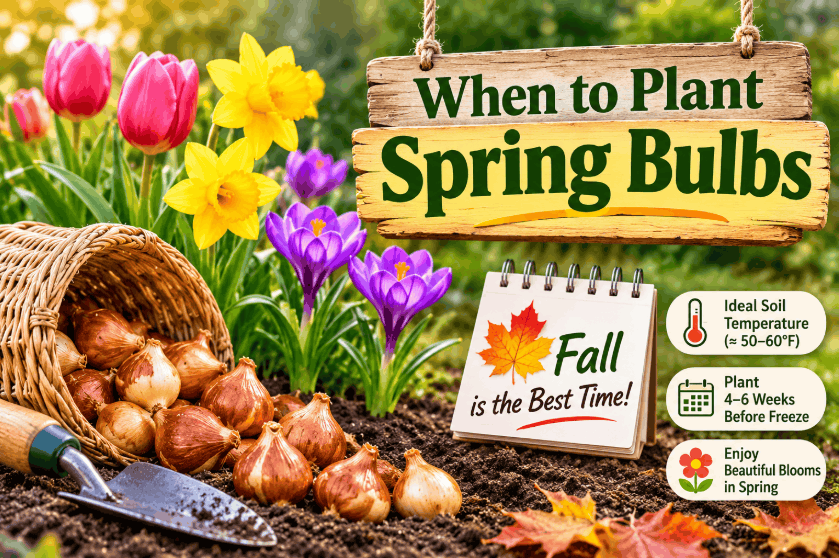
Plant spring bulbs in fall when soil temperatures fall below 60°F and approximately four to six weeks remain before the ground freezes. This gives tulips, daffodils, and other hardy bulbs time to establish roots before winter, while the cold period supports spring flowering.
Key Takeaways
- Spring bulbs are generally planted in fall when soil at planting depth drops below 60°F. Nighttime temperatures of 40°F to 50°F can serve as a regional cue that the soil is cooling.
- Extension guidance gives the ideal timing as about four to six weeks before the ground freezes, which gives roots time to form.
- State extension windows run from mid-September in New Jersey to late December in Georgia.
- Bulbs can still be planted while the soil is workable and not frozen. Root development depends on the bulb species and soil conditions, so 40°F should not be treated as a universal minimum root-growth threshold.
- Bulbs held until spring usually fail: unplanted spring-flowering bulbs typically dry up and die over winter.
When should spring bulbs be planted?
Plant spring bulbs in fall, once the soil cools below sixty degrees Fahrenheit and about four to six weeks before the ground freezes. That puts planting in September or October across much of the North and as late as December in parts of the South.
Soil at planting depth (the level where the bulb will sit) should read below 60°F. Use a soil thermometer inserted to the depth where the bulb will sit rather than relying on the air temperature alone.
Take readings in the early morning over several days and look for a consistent trend. Soil temperature can vary with sunlight, weather, and location within the garden, so a single afternoon reading may not represent the conditions around the planting bed.
Nighttime air temperatures holding between 40°F and 50°F, a cue used in South Dakota guidance, can indicate that autumn soil is cooling. Calendar dates alone can be misleading because autumn soil temperatures vary from year to year.
Four to six weeks gives roots time to form. University of Illinois Extension puts the ideal planting time at about four to six weeks before the ground freezes (when the soil itself turns solid). Some gardening guides cite six to eight weeks, but the extension sources reviewed here give four to six.
Some spring-flowering bulbs may produce foliage in fall, depending on the species and local conditions. Follow the planting guidance for the specific bulb rather than treating fall growth as a universal sign of planting too early.
Planting too late leaves too little root growth before the ground freezes. If the soil is still above 60°F, wait; if it’s below 60°F and the ground is weeks from freezing, plant.
When should spring bulbs be planted in each region?
Regional planting windows vary from mid-September in New Jersey to late December in Georgia, reflecting differences in autumn temperatures and winter conditions.
Hardiness zone (a USDA category based on a location’s average coldest winter temperature) is a rough climate guide. It measures how cold winters get, not when fall soil cools. The examples below come from state extension guidance.
They illustrate regional differences rather than providing a complete planting calendar for every state.
| State or region | Extension-supported planting guidance |
|---|---|
| New Jersey | Mid-September through October |
| South Dakota | Mid-September through mid-October |
| Eastern Nebraska | Late September through the end of October |
| Iowa | October is the ideal planting period; plant before the ground freezes |
| Illinois | Approximately mid-October through early November |
| North Carolina | October in Zone 6; November or early December in Zones 7 and 8 |
| Western Oregon | October and November; planting may continue into mid-December if soil remains workable |
| Central and Eastern Oregon | Late September through October |
| Georgia | October through late December in most areas |
These dates are regional examples, not a complete national calendar. Planting conditions vary across the United States, including in California, the Southwest, the Gulf Coast, Florida, Hawaii and other mild-winter areas.
Where a state-specific window is not listed, check the local Cooperative Extension service and the instructions for the selected bulb. In warmer climates, the suitability of the bulb and its chilling requirement can matter more than a general fall planting date.
- The Midwest and Mid-Atlantic rows overlap heavily, with October named most often, while the Southeast starts later.
- On North Carolina’s Outer Banks, extension guidance says late November to early December, two to three weeks before the ground freezes, which is shorter than the usual four to six.
- Windows vary even inside one state’s guidance: Nebraska’s extension publications give late September through early October in one and the end of October in another.
- Climate also shifts bloom time: bulbs flower two or more weeks earlier in zone 9 than in zone 7, according to Georgia guidance.
- No authoritative planting window turned up for Hawaii or the U.S. territories, and Alaska’s extension service describes fall planting with mulch, adding that snow cover or mulch is a must in Fairbanks.
To find a local planting date for spring bulbs, look up the USDA hardiness zone by ZIP code and check local National Weather Service freeze dates. Then watch soil temperature at planting depth until it holds below 60°F.
The soil reading sets the date; the zone and freeze dates only show when to start checking.
The USDA Plant Hardiness Zone Map (planthardiness.ars.usda.gov) takes a ZIP code, and the 2023 version is the current map. National Weather Service offices publish local first-freeze dates built from 1991 to 2020 records, where a freeze is 32°F or colder, and a hard freeze is 28°F or colder.
Neither the USDA hardiness zone nor the average first-freeze date identifies the exact day to plant every bulb. Hardiness zones describe winter temperature extremes, while freeze dates describe historical weather patterns.
Use both as planning references, then consider the selected bulb’s requirements, local soil temperature, and expected ground-freezing conditions.
Mild-winter regions: chilling bulbs first
University of Georgia Extension recommends 12 to 16 weeks of prechilling at 40°F to 50°F for most spring-flowering bulbs that need artificial chilling in extremely mild-winter areas. The requirement varies by species and cultivar, and some bulbs may already have been prechilled by the supplier.
Check the bulb label or supplier instructions before refrigerating bulbs. Keep bulbs in ventilated packaging during the cold treatment.
Is it too late to plant spring bulbs?
Spring bulbs can still be planted as long as the ground is workable and not frozen. Root development and flowering performance depend on the bulb species and remaining growing conditions, so plant firm bulbs as soon as possible. Once the ground is frozen solid, force the bulbs indoors in pots instead.
The practical cutoff is whether the soil is still workable and not frozen. Match the situation to the step:
- Soil is workable and not frozen: Plant firm bulbs as soon as possible. Fall planting gives them an opportunity to establish roots before winter.
- Soil has only recently thawed: Planting may still be possible if the soil can be worked. Root development and flowering performance depend on the bulb and remaining growing conditions.
- Ground is frozen solid: Pot the bulbs and force them (grow them indoors after a cold period) instead of holding them for spring.
Some spring bulbs can still be planted in December where the soil remains workable and local conditions permit. Late planting still beats holding bulbs over winter, which extension guidance advises against. Waiting until the ground freezes can eliminate the opportunity for fall planting.
How to store bulbs until planting
Store bulbs in a dry area at approximately 60°F to 65°F until planting day. Georgia Extension warns that temperatures above 70°F may damage flower buds.
Follow the supplier’s storage instructions and plant bulbs as soon as practical after purchase. Choose plump, firm bulbs, and skip any that are soft, moldy, or already sprouting.

What happens if spring bulbs are planted in spring?
Spring-planted bulbs rarely bloom well that year. Iowa State University Extension and Outreach says unplanted spring-flowering bulbs typically dry up and die over winter, and the ones that survive usually don’t perform well when planted in spring.
Spring planting skips two things bulbs need: time to grow roots and a stretch of cold that starts flower development. Many hardy spring-flowering bulbs need a period of cold to support normal flowering, although the requirement varies by species and cultivar.
Firm bulbs planted in spring may still flower eventually, but soft, mushy, or hollow ones should be discarded. If bulbs cannot go into the ground before winter, indoor forcing in pots is another option.
University of Georgia Extension recommends keeping potted bulbs in darkness at about 40°F for eight to 12 weeks, without allowing them to freeze or the potting soil to dry out.
After chilling, move the pots to a cool, bright location. Flowers may open in about one month. Other extension recommendations use different chilling periods, so follow instructions for the particular bulb.
Forced bulbs seldom rebloom when planted outdoors afterward. Spring-flowering hardy bulbs and summer-flowering tender bulbs follow different planting schedules. Tulips, daffodils, and crocuses are generally planted in fall for spring flowers.
Summer-flowering bulbs are generally planted in spring after the danger of frost has passed. Their planting depths, temperature requirements, and care instructions should not be assumed to match those of fall-planted spring bulbs.
What soil, sun, and drainage do spring bulbs need?
Most common spring-flowering bulbs grow best in well-drained soil, a pH around 6 to 7, and a site receiving about five to six hours of direct sun a day. Requirements vary by species.
| Requirement | Figure |
|---|---|
| Soil pH | 6 to 7 |
| Direct sunlight | At least 5 to 6 hours a day |
| Drainage | Well-drained soil |
| Heavy clay | Address drainage problems and use locally recommended soil amendments |
| Sandy soil | Use locally recommended organic amendments where soil improvement is needed |
| Under deciduous trees | Early-flowering bulbs can grow there |
| Soil test | Shows whether lime or fertilizer is needed |
Good drainage is essential because persistently wet soil can cause bulbs to rot. A soil test helps determine whether the soil needs lime to adjust its pH.
Fertilizer needs vary with soil conditions and bulb type. Do not assume that every planting bed needs the same fertilizer treatment. Use a soil test and local extension recommendations to determine whether fertilizer is needed, and follow the product label for application rates and placement.
How deep and how far apart should spring bulbs be planted?
Rutgers Cooperative Extension recommends planting most large bulbs, including tulips and daffodils, about eight inches deep and small bulbs such as crocus about three to four inches deep. Rutgers measures planting depth from the bottom of the bulb to the soil surface.
Check the specific bulb’s planting instructions because recommendations and measurement conventions vary among extension authorities. Plant pointed-end up. The same orientation is used when planting garlic cloves, although garlic requires different planting depths and spacing.
Rutgers Cooperative Extension bases depth on two to three times the bulb’s height. It spaces large bulbs such as tulips and daffodils about eight inches apart and small bulbs such as crocus and anemones three to four inches apart.
These figures are general guidance rather than a substitute for species-specific instructions. Extension publications do not always use the same depth-measurement convention. Follow the planting depth supplied for the particular bulb and use the same reference point when measuring it.
Spacing runs tighter in North Carolina guidance, at three to six inches for large bulbs.
- Contact 811 before digging and submit a utility-location request according to your state’s requirements. Even shallow gardening work can encounter underground services.
- Wait until the required response period has passed and the participating utility operators have marked or cleared their lines. The 811 process may not identify privately owned lines, such as some irrigation, lighting, or other property-specific services. Arrange a separate private utility locate when necessary.
- Dig and loosen the whole bed to the planting depth, because a bulb planter works poorly in compacted or rocky soil and a fully dug bed drains better.
- Set each bulb pointed end up, with the root plate (the flat base where roots emerge) down.
- Cover with soil and water once to settle it, without soaking the bed.
- Apply mulch according to local conditions. For winter protection, follow regional extension recommendations for the appropriate timing and depth.
Alaska guidance is shallower, at five to six inches deep for tulips and daffodils and two to three inches for small bulbs such as scilla and grape hyacinths.
After planting: watering, mulch, and protection
Newly planted bulbs need one good watering to settle the soil, then little more unless fall stays dry. Extension guidance ranges from one watering plus rain to a deep weekly soak in dry weather, and none of it calls for daily or alternate-day watering. Overwatering at planting can cause bulb rot.
In spring, provide about one inch of water a week from bud through early foliage if rainfall has not supplied that amount. Water deeply enough to reach the bulb’s root zone, since some large bulbs are planted several inches below the surface.
Mulch depth and timing depend on the climate and purpose. Rutgers recommends two to three inches of organic mulch to help control weeds.
In Minnesota, University of Minnesota Extension recommends applying winter-protection mulch after the soil begins to freeze to reduce temperature fluctuations and premature growth. Remove or reduce protective mulch as the soil thaws in spring, while keeping material available if a late freeze threatens emerging shoots.
Voles, squirrels, rabbits, and deer may feed on susceptible bulbs, including tulips and crocuses. Cover susceptible bulbs at planting with wire mesh that lets shoots grow through, since repellents may still be necessary.
| Mistake | What happens | Fix |
|---|---|---|
| Planting before soil cools | Top growth sprouts, and winter can kill it back | Wait for soil below 60°F |
| Waiting until the ground freezes | Roots can’t form | Plant once the soil can be dug |
| Overwatering at planting | Bulb rot | Water once to settle the soil |
| Poorly drained soil | Soggy soil promotes rot | Address drainage problems and use locally recommended soil amendments |
| No animal protection | Tulips and crocuses get eaten | Cover with wire mesh at planting |
| Leaving faded flowers on | Seed formation takes food from the bulb | Cut off faded flowers |
| Cutting leaves after bloom | Smaller, weaker bulb | Leave leaves until they yellow |
| Applying fertilizer without checking soil needs | Unnecessary or unsuitable fertilizer applications can affect bulb performance | Use soil-test guidance and follow bulb-specific extension recommendations and product labels |
Conclusion
Soil temperature and local ground-freezing conditions provide better planting guidance than a fixed calendar date. Wait for soil below 60°F, aim for four to six weeks of root growth before the ground freezes, and plant firm bulbs while the soil can still be dug.
Unplanted bulbs often deteriorate over winter, so planting before the ground freezes is generally preferable to holding them until spring.
FAQs
What is the best month to plant spring bulbs?
There is no single best month. Extension guidance recommends October for Iowa and Maryland, mid-September through October for New Jersey, and November for North Carolina. Soil below 60°F is a more reliable planting cue than the calendar.
How can soil temperature be checked before planting bulbs?
Measure soil at bulb-planting depth using a local resource such as Nebraska Extension’s Crop Watch or the NC Climate Office. Where unavailable, South Dakota guidance uses consistent nighttime temperatures of 40°F to 50°F as a cooling cue. Plant when soil drops below 60°F.
Should tulips be planted later than daffodils?
Daffodils can be planted slightly earlier, while tulips tolerate late planting. Clemson Cooperative Extension recommends October or November for daffodils. For other spring bulbs, wait until soil at planting depth stays below 60°F. Separate national planting dates are not established.
Can spring bulbs be planted in pots?
Yes. Plant bulbs in pots during the fall planting window, allowing enough time for their required chilling period. Because containers experience colder temperatures than garden soil, protect them in cold climates by grouping pots, adding mulch, and wrapping them with insulation. Check the bulb’s chilling requirements before choosing a variety for container planting.
Which spring bulbs suit a given zone and soil?
Choose bulbs suited to your USDA hardiness zone and local soil conditions. Tulips are often short-lived in warm soil, and eastern North Carolina guidance treats them as annuals. Most spring bulbs prefer well-drained soil with a pH of 6 to 7. Snow cover or mulch is essential for winter protection in Fairbanks.
Which way up do spring bulbs go?
Pointed end up. Tulips, daffodils, and hyacinths go in with the point of the bulb upward and the root plate (the flat base where roots emerge) downward. Set the bulb so its base rests at the planting depth, then cover it with soil.
Can spring bulbs be planted in a lawn?
Yes. Plant early-flowering bulbs in lawns, but delay mowing until their foliage yellows and dies back naturally. The leaves replenish the bulb for the next season. Choose varieties suited to your climate and mowing schedule.
Are spring bulbs poisonous to pets?
Yes. The ASPCA lists tulips, hyacinths, irises, and daffodils as toxic to dogs and cats, with toxins concentrated in the bulbs. Spring crocuses can cause stomach upset, while autumn crocus (Colchicum autumnale) can cause severe poisoning. Keep pets away and contact a veterinarian or ASPCA Animal Poison Control at 888-426-4435 if ingestion is suspected.
Editorial review: Conditions vary by region, soil, and winter weather, so local extension guidance and plant tags take precedence over general dates. Call 811 before any digging, even for flower beds.