

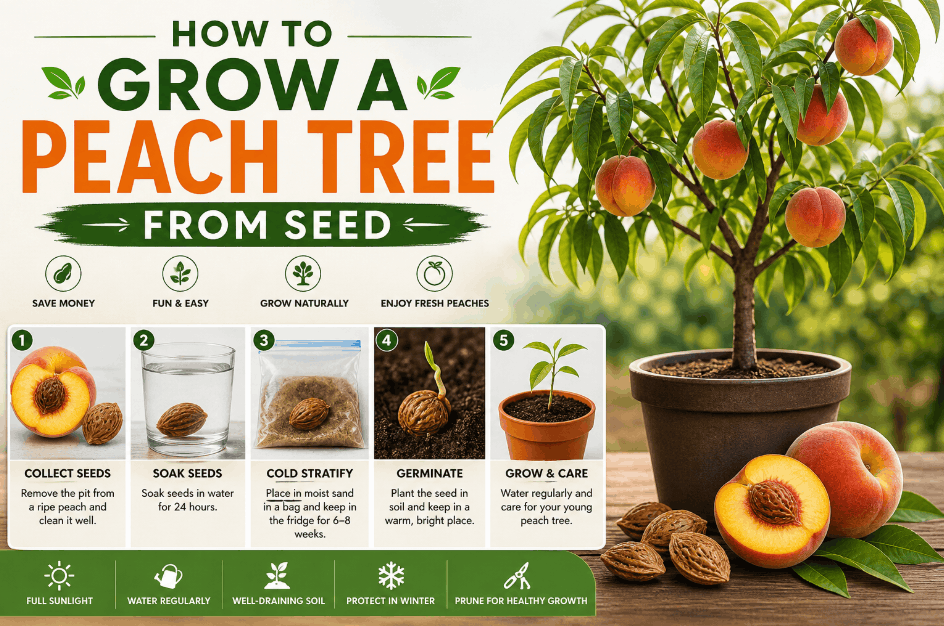
Growing a peach tree from seed means cleaning a pit, chilling the seed inside it until a root tip appears, then planting the sprout in well-drained soil. The result is a new seedling, not a copy of the original peach, and fruit can take years.
- Poison Control says peach pits contain amygdalin, a compound that can create cyanide when digested, and advises calling 1-800-222-1222 if someone eats a pit.
- Published guides disagree on seed chilling time, from about one month to about fifteen weeks, so a visible root tip is a better signal than counting days.
- University of New Hampshire Extension does not recommend seedling rootstocks (seed-grown root systems for grafted trees) for home gardens because of their large size.
How to Grow a Peach Tree From Seed?
To grow a peach tree from seed, clean the pit and chill the seed in the refrigerator until a root tip appears. Then plant the sprout in a deep, well-drained pot and gradually move the seedling outdoors to full sun.
- Save the pit from a fully ripe peach. University of Kentucky Cooperative Extension notes that seeds from peaches ripening after August 1 germinate better than those from early-maturing cultivars.
- Scrub off all fruit flesh; University of Georgia Extension notes that seeds stored with leftover plant pulp can mold and deteriorate.
- Decide whether to crack the pit. University of California Agriculture and Natural Resources describes extracting the seed from the pit first, while Penn State Extension notes that either extracted seeds or whole pits can be chilled.
- Chill the seed or whole pit in the refrigerator in a barely moist medium, never frozen, until a root tip appears.
- Plant the sprout, root pointing down, in a deep container of well-drained potting mix.
- Grow it in bright light, then harden it off (gradually expose it to sun and wind) before moving it outside.
- Transplant to a full-sun, well-drained spot once roots are well developed.
Start several pits, since Oklahoma State University Extension notes up to 50 percent of seeds may be dormant at ripening, and label the result a seedling rather than the parent variety because fruit trees do not grow true to variety from seed.
How do you crack a peach pit open safely?
A peach pit is the hard stone around the seed, called the kernel. Cracking it is optional, and the kernel contains amygdalin, a compound that can create cyanide when digested, so handle it with care.
Poison Control says swallowing one pit is unlikely to cause poisoning, but eating several unprocessed pits can produce symptoms, and some pits may contain enough amygdalin to harm very small children.
- Skip cracking entirely if preferred; Penn State Extension states that either extracted seeds or whole pits can be chilled.
- Use pliers or a nutcracker rather than striking the stone; University of California Agriculture and Natural Resources recommends pliers to crack the pit carefully.
- Apply gentle, steady pressure along the pit’s seam until the hard outer stone opens, leaving the brown seed coat intact (University of California Agriculture and Natural Resources).
- Stop as soon as the stone opens; University of Georgia Extension notes that a living embryo inside an undamaged seed is needed for germination.
- Never eat the kernel, and keep cracked seeds away from young children (Poison Control).
- After any ingestion, call Poison Control at 1-800-222-1222 or use its online tool.
How long should a peach seed be chilled before it sprouts?
University extension guides give peach seed chilling times from about six weeks to about nineteen weeks at cool temperatures, so no single number is settled. Watching for a white root tip is a more reliable signal than counting days.
Once the pit is cracked or left whole, the seed needs cold stratification (a stretch of cool, moist conditions that mimics winter and ends dormancy). Penn State Extension states that peach seeds require this chilling period so the embryo can finish developing.
Five university extension sources give different ranges:
| Source | Chilling time | Temperature |
| UC Agriculture and Natural Resources | 6 to 8 weeks | Refrigerator temperature |
| Oklahoma State University Extension | 75 to 100 days | 32 to 45°F |
| University of Georgia Extension | 90 to 130 days | 35 to 50°F |
| Penn State Extension | 120 to 130 days (at least 60 days in fridge) | 33 to 50°F (45°F best) |
| Iowa State University Extension | Varies by tree species | 32 to 41°F |
Penn State Extension’s table lists 120 to 130 days for peach after-ripening, while its refrigerator instructions advise keeping seeds chilled in moist medium from mid-January for at least 60 days until after the last severe spring frosts.
Seed chilling and a tree’s winter chill are measured differently. Clemson Cooperative Extension counts that tree chill in hours at or below 45°F, while UF/IFAS Extension counts hours between 32°F and 45°F.
To germinate a peach seed, place it in a barely moist medium such as peat moss, sand, or a damp paper towel inside a sealed jar or plastic bag in the refrigerator, never frozen, and away from ethylene-producing fruits like apples or bananas (Penn State Extension, University of California Agriculture and Natural Resources).
Check regularly for mold and dryness, and move the seed to a pot when it sprouts. Penn State Extension advises starting refrigerator stratification in mid-January so seeds chill for at least 60 days until after the last severe spring frosts, then planting in early April.
How do you plant a sprouted peach seed?
Plant a sprouted peach seed with its root pointing down in a deep, well-drained container, cover it lightly with soil, and water it gently. Keep the mix moist but not soggy, then harden the seedling off before moving it outdoors.
- Fill a tall container that has drainage holes with clean seed-starting media; University of Georgia Extension notes that media must drain well enough to supply oxygen to developing roots and be free of contaminants.
- Lay the sprout root-down, cover it lightly without damaging the root, and water gently; University of Georgia Extension advises keeping the media evenly moist to the touch but never waterlogged.
- Place the pot in a warm spot with bright, indirect light at first; University of Georgia Extension recommends lowering the temperature to about 65°F after germination and moving seedlings to strong light as shoots appear.
- Harden the seedling off before transplanting outdoors in spring after frost risk has passed (University of Georgia Extension, Penn State Extension).
Planting depth depends on seed size. Penn State Extension advises planting fruit tree seeds in a furrow no deeper than one to two times the longest dimension of the seed, topped with a light cover of soil and 1 to 2 inches of sand for fall-planted beds to prevent soil crusting.
Can a peach seed grow indoors?
University of California Agriculture and Natural Resources and University of Georgia Extension describe starting germinated seedlings indoors in tall pots under bright light until spring planting.
Without enough indoor light, seedlings grow weak and spindly (University of Georgia Extension), and a grown tree has bigger demands: University of Georgia Extension says peach trees need 8 to 10 hours of sun a day.
When should the seedling move outdoors, and where?
Size triggers and stages vary across extension guides: Penn State Extension begins nursery care when seedlings reach 6 to 8 inches tall, while University of Illinois Extension lists 2 to 4 feet as the preferred size range for planting young nursery peach trees into their permanent spot.
Clemson Cooperative Extension says most fruit trees grow best where soil pH is near 6.5. University of Georgia Extension Circular 877 adds that poorly drained sites benefit from a raised mound or bed at least 3 feet wide.
What if a chilling seed molds, dries out, or will not sprout?
When a chilling peach seed molds, dries out, or stays closed, the fix depends on the cause. Too much water or leftover fruit flesh invites mold, a dry medium can end sprouting, and a stubborn seed may need more time in cold stratification.
- Mold: University of California Agriculture and Natural Resources and University of Georgia Extension warn that overly wet media or leftover fruit pulp causes mold and seed rot, so keep the towel or medium damp rather than wet.
- Dried out: University of Georgia Extension notes that too little moisture causes the embryo to die, so monitor the medium regularly to keep it moist.
- Still closed: Oklahoma State University Extension notes that up to 50 percent of peach seeds may be dormant and require 75 to 100 days at 32 to 45°F, while Penn State Extension lists up to 120 to 130 days for complete after-ripening.
- Outdoor seeds and animals: Penn State Extension advises placing a wire screen or hardware cloth over outdoor fall-planted seed rows, with all edges pushed several inches into the soil and the ends closed, to keep chipmunks and squirrels from digging up the seeds.
Which US regions get enough winter cold for peach seeds and trees?
Peach trees need winter chill, counted in hours at or below about 45 degrees Fahrenheit, and every region supplies a different amount. Mild-winter areas such as Florida and the coastal Southeast call for low-chill varieties, while cold-winter areas can chill seeds outdoors.
| Region | What sources report | Source |
|---|---|---|
| Florida | Older advice: varieties needing 400 to 500 chill hours | UF/IFAS Extension |
| Florida | Newer advice: varieties needing about 300 chill hours, since recent winters supplied fewer | UF/IFAS Extension |
| Florida | Classes: low under 250 chill units, medium 300 to 525, high over 525 | UF/IFAS Extension |
| Georgia | Chill-hour calculator counts October 1 to February 15 | University of Georgia Extension |
| Cold-winter areas | Seeds planted outdoors in autumn are chilled by winter | Philadelphia Orchard Project |
| All regions | A seedling’s chill requirement may differ from its parent’s | Grow Organic |
The USDA Plant Hardiness Zone Map (2023 edition, 13 zones in 10°F steps) shows a zone by ZIP code, and a county Extension office can help with local chill hours.
How long does it take a peach seed to grow into a tree that fruits?
Extension guides state that peach trees generally begin bearing fruit in about three to five years, though seedlings grown from seed can take longer depending on genetics, climate, and care.
Oklahoma State University Extension notes that peach trees typically begin bearing a crop in the third year and reach full production by year five, though trees started from seed first must grow through their juvenile seedling stage.
A seedling passes through a juvenile period before it is mature enough to flower, which varies with growing conditions and care. On final size, University of Connecticut Home & Garden Education Center and University of Tennessee Extension note that standard, non-dwarf peach trees grow to 15 to 20 feet tall.
Clemson Cooperative Extension says too little winter chill can delay leafing and flowering, reduce fruit set and quality, and cause small, misshapen fruit.
Is a seed-grown peach tree worth it compared with a grafted tree?
A seed-grown peach tree suits growers who accept an unpredictable tree and a long wait. A grafted tree (a named variety joined to a separate root system) suits growers who want known fruit and a shorter wait.
University extension sources agree that peach seeds do not reliably duplicate the parent tree. Penn State Extension states that seeds collected from fruit produce a hybrid of two plants, and Oklahoma State University Extension confirms that fruit trees do not bear true to variety when propagated by seed.
- Choose a seedling for a learning project; University of Tennessee Extension notes that unnamed seedlings lack predictable disease resistance and size control compared with selected cultivars.
- Choose a grafted tree for a named variety; Oklahoma State University Extension notes that commercial varieties are budded or grafted to guarantee fruit true to the desired variety.
- Plan for size. University of New Hampshire Extension does not recommend seedling rootstocks (seed-grown root systems for grafted trees) for home gardens. It calls the large trees hard to prune, harvest, and manage for pests.
- Keep an exit: Oklahoma State University Extension and Penn State Extension note that peach seedlings grown from fall-planted or stratified pits can be budded or grafted to a desirable peach variety as rootstock.
Conclusion
A peach seed grows into a tree when it is cleaned, chilled until a root tip appears, and planted in well-drained soil with plenty of sun. The most useful rule is to watch the seed, not the calendar, and to expect a tree whose fruit may differ from the original peach.
Winter chill, frost dates, and pests differ by region, so a county Extension office is the best check for local timing. Product labels take precedence for any spray, and a licensed professional should handle chemical applications.
FAQs
Do peach seeds need to dry before planting?
Peach pits should be air-dried briefly to remove surface moisture, but never left out long enough to dehydrate the inner seed. Penn State Extension recommends air-drying cleaned pits before cold storage, while Oklahoma State University Extension warns that prolonged drying significantly reduces seed viability.
Can a peach seed sprout in water or without chilling?
No, peach seeds require cold, moist conditions to break natural embryo dormancy and will rot if submerged in standing water. Penn State and UGA Extensions advise cold-stratifying seeds in a damp medium at 33°F to 50°F for 60 to 130 days to ensure proper germination and provide the oxygen the embryo needs to breathe.
Which insects damage peach trees most?
The most destructive peach insect depends on the region: peachtree borer is the top pest in western states, while plum curculio causes the most fruit damage in the Southeast. Gummy sap at the base of the trunk indicates peachtree borer (CSU Extension), whereas crescent-shaped fruit scars signal plum curculio (UGA Extension).
Does a young peach seedling need pruning?
Yes, young peach seedlings require pruning to develop an open-center vase shape, but heavy trimming should be avoided because it delays fruit production. UGA Extension Circular 877 and Clemson Extension HGIC 1355 recommend establishing 3 to 5 primary scaffold branches while removing competing central shoots.
How should a young peach seedling be watered?
Young peach seedlings should be kept evenly moist to the touch, not waterlogged, with container trees checked daily and in-ground trees watered deeply every 10 to 12 days. UGA Extension notes that weed competition quickly dries out young root zones, and recommends withholding first-year fertilizer until spring.
Disclaimer: This article is for informational purposes only; always verify horticultural practices, chemical usage, and safety regulations with your local Cooperative Extension or a licensed professional before proceeding. Editorial review conducted on October 12, 2026. Information verified against current extension data and USDA guidelines. Scheduled for annual review.