

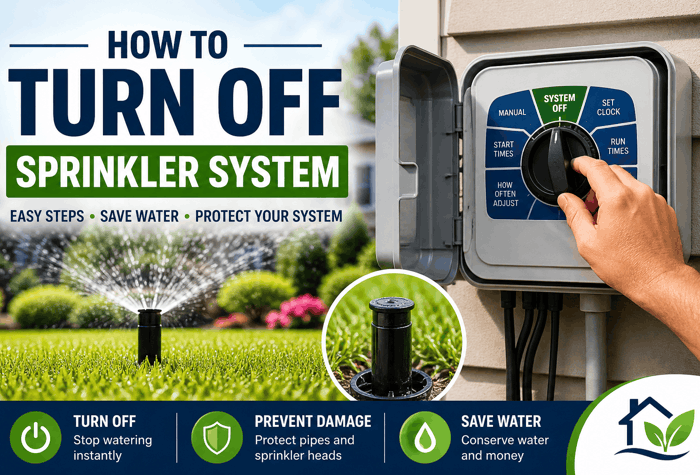
Turning off a sprinkler system means stopping it in two separate ways. Setting the controller, the timer that sends start signals to the zone valves, to Off cancels scheduled watering. Closing the irrigation shutoff valve cuts the water supply to the pipes.
The controller stops the schedule, but only the valve stops the water.
Key Takeaway
- A controller set to Off stops scheduled watering but cannot close a zone valve that is stuck open. Hunter Industries lists debris under the valve diaphragm as the most common cause of a valve that will not close.
- Ball valves close with a quarter turn and gate valves take many turns. Clemson Cooperative Extension advises closing ball valves slowly to avoid water hammer, a pressure surge that strains pipes.
- A water meter confirms a shutoff. The City of Leander, Texas, says that if the dial stops moving after the irrigation valve is closed, the irrigation system was leaking.
How do you turn off a sprinkler system at the controller?
To turn off a sprinkler system at the controller, set the dial to Off or press the Off key. This cancels active watering and blocks scheduled cycles while keeping the saved schedule. The setting stops the timer’s signals, not a stuck valve.
- Find the controller, the box or panel wired to the zone valves.
- Turn the dial to Off, or press the Off key on keypad models. Rain Bird’s quick-reference manual says the Off key immediately cancels all active watering.
- Controller layouts vary by manufacturer and model. Use the label, display menu, or manual to identify the Off control if the controller has no dial or clearly marked Off key.
- On Wi-Fi or Bluetooth models, check the app too, because EPA WaterSense notes these controllers connect to a mobile device.
- Leave the controller plugged in.
| Setting | What it does | Limit |
|---|---|---|
| Off | Cancels active watering and blocks scheduled cycles; the saved schedule stays | Does not close a zone valve stuck open |
| Rain Delay | Pauses watering, then the schedule resumes on its own | Length varies by model: 24, 48, or 72 hours on some Orbit timers; Rain Bird models range from up to 72 hours on some SST controllers to up to 14 days on ESP-ME3, TRU, and WiFi Smart Controller models, and up to 30 days on LXME2 models. |
Rain Bird and Orbit manuals both describe Off as the setting that stops all stations. A City of Round Rock, Texas, guide to a Rain Bird controller adds that Off does not erase the programming.
How do you shut off the water to a sprinkler system?
To shut off the water to a sprinkler system, close the irrigation shutoff valve ahead of the backflow preventer. Turn a ball valve a quarter turn until the handle sits across the pipe, or turn a gate valve until it stops. Turn slowly.
The Texas Commission on Environmental Quality (TCEQ) places an isolation valve, which cuts off one section of a water line, between the water meter and the backflow preventer. That device keeps irrigation water from flowing back into the drinking supply.
The valve normally sits in a valve box, and Texas has required one on every new irrigation system since January 1, 2009.
| Shutoff point | Where it is found | How it closes |
|---|---|---|
| Isolation valve before the backflow preventer | Valve box between the water meter and the backflow device | Ball valve: quarter turn until the handle sits across the pipe. Gate valve: turn until it stops |
| Isolation valves on the backflow preventer | On the device, often in a garden bed or along a house or garage wall | Quarter turn on each handle until it sits across the pipe |
| Stop-and-waste valve | Basement, crawlspace, or underground box, sometimes 5 feet down, per Colorado State University Extension | Long key; never force it |
On a ball valve, closed means the handle sits across the pipe, and open means it runs parallel with the pipe.
Clemson Cooperative Extension explains the difference: a gate valve lowers an internal gate as the handle turns many times, while a ball valve rotates a drilled ball a quarter turn. Close ball valves slowly, because fast closing can cause water hammer, a pressure surge that bangs and strains pipes.
How do you shut off sprinklers without shutting off the whole house?
Close one of the irrigation-only valves: the isolation valve before the backflow preventer, the handles on the device, or a stop-and-waste valve. The main house valve and the utility’s meter valve control household water, so they stay open unless nothing else works.
What do you do when a sprinkler system won’t turn off?
When a sprinkler zone will not stop, close the irrigation shutoff valve first, then set the controller to Off. A zone that keeps running with the controller off has a valve that will not close, which a manual shutoff or a licensed irrigator can fix.
- Close the irrigation shutoff valve slowly, as described in the water supply section. Hunter Industries warns that opening a valve under pressure is dangerous, so the pressure comes off first.
- Set the controller to Off.
- Check for a valve opened by hand. In the valve box, turn the solenoid (the black cylinder with two wires on top of the valve) clockwise until snug, and hand-tighten the bleed screw.
- Restore the water slowly and watch the zone. A zone that still runs with the controller off usually has debris under the valve diaphragm (the flexible seal that opens and closes the valve). Close the supply again.
- Call a licensed irrigator if a handle will not turn, a backflow assembly leaks, or the zone still runs. TCEQ advises this for a leaking assembly or any leak after startup.
A zone valve that keeps running with the controller off or unplugged usually has debris caught between its diaphragm and seat, according to Hunter Industries. Closing the water supply first removes the pressure that makes opening a valve dangerous.
A valve opened by hand closes again when the solenoid is turned clockwise until snug or the bleed screw is hand-tightened.
When is the meter-box valve a last resort?
If no irrigation valve can be closed and water keeps flowing, the utility’s valve in the meter box is the final option. Contact the water utility before using this valve unless there is an immediate emergency. Utility access rules and liability for damage vary by location.
How do you turn off one sprinkler zone manually?
To turn off one sprinkler zone manually, open its valve box and twist the solenoid clockwise until it is snug. If the valve has a bleed screw, hand-tighten that instead. Hunter Industries says some trickling from the bleed screw during manual operation is normal.
- Find the valve box. Clemson Cooperative Extension describes it as a small box set at ground level, usually with a green lid. Do not dig to locate a buried valve box; contact the local water utility or a licensed irrigator for help locating underground components.
- Identify the parts. The solenoid is the black cylinder with two wires, and the bleed screw sits on top of the valve.
- Close the valve by hand. Opening takes a quarter to half turn counterclockwise, so a loose part suggests someone opened the valve by hand.
- Know the limit. Clemson says a valve turned on by hand must be turned off by hand, because the controller cannot close it.
How can you tell a sprinkler system is really off?
To confirm a sprinkler system is really off, stop all other water use, close the irrigation shutoff valve, and read the water meter. A dial that is not moving means no water is flowing. A dial that keeps moving means water is going elsewhere.
With every faucet and appliance off, the City of Leander, Texas, says an analog meter shows flow as a turning dial needle, and slower leaks as a slowly turning pinwheel indicator. Electronic meters show digits that keep changing.
A slowly turning pinwheel on the meter face signals a slow leak, even when the dial needle looks still.
Then close the manual cutoff just before the backflow preventer, or close the backflow preventer handles, and check again. If the movement stops, the irrigation system was leaking.
If it keeps going, the City of Leander’s guide points to other sources, such as faucets, toilets, or a pool refill, and suggests a licensed plumber when the source stays hidden. A meter that stops while a sprinkler head still drips is explained in the next section.
Why does a sprinkler system keep leaking after it is turned off?
A sprinkler system keeps leaking after shutoff for two reasons, according to Hunter Industries. Water can drain out of the lowest sprinkler head, called low head drainage, or water can seep through a zone valve that debris is holding open.
| Symptom | Likely cause | What to do |
|---|---|---|
| Water drips from the lowest head on a zone, then stops by itself | Low head drainage: water drains from the pipes through the lowest head | Add check valves, which hold water in the pipe, to the sprinklers or lateral lines (the pipes branching off to the heads) |
| Water keeps seeping from a zone and never stops | Debris blocking the zone valve diaphragm | Close the water supply, take the valve apart, rinse the parts with clean water, and reassemble; replace a damaged diaphragm |
| The meter dial still moves with the irrigation valve closed | The leak is not in the irrigation system | Check faucets, toilets, and wet yard patches; hire a licensed plumber if the source stays hidden |
Hunter Industries says residual water from low head drainage stops once the pipe has emptied, so a drip that never stops points to the zone valve. The right fix can also depend on the setup; learn more about different types of sprinkler systems.
Can a sprinkler system turn itself off, and is automatic or manual shutoff better?
Yes, a sprinkler system can shut itself off when it rains. A rain or soil sensor interrupts watering when the weather turns wet. Automatic shutoff does not replace the valve, because leaks, repairs, and freezing weather call for closing the water supply by hand.
The University of Florida IFAS Extension explains that, after enough moisture, a rain sensor signals the irrigation controller to delay watering until conditions dry. Wired sensors may connect through the controller’s rain-sensor port or common wire.
The extension recommends testing it once a year by spraying it with a hose while a zone runs. EPA WaterSense advises installing a rain or soil sensor to turn the system off when the weather turns wet.
Choose automatic shutoff to skip watering after rain, and choose the valve whenever water must stop for certain. A sensor signals the controller, so it does not close a zone valve that debris holds open.
Cost depends on the device. Off and Rain Delay are built into the controllers in the manufacturer manuals and need no add-on.
A rain sensor is a separate part whose price depends on its type and whether it is wired or wireless. UF/IFAS identifies cork-disc, or expanding-disk, sensors as among the most common and effective; in 2021, it described many models as costing about $18 to $30.
A smart controller costs more than a basic controller, and prices and available rebates vary by model and utility. For a broader view of installation expenses, see how much it costs to install a sprinkler system.
Does turning off a sprinkler system for winter protect it from freezing?
No. Shutting off the water supply stops new water from entering, but water already in the pipes can still freeze. Colorado State University Extension says the lines must be drained, and that drain valves alone cannot be trusted.
For a lower-intervention approach, see how to winterize a sprinkler system without a blowout. Water expands by one-eleventh as it freezes at 32 degrees Fahrenheit, so about 11 cubic feet of water forms about 12 cubic feet of ice, according to Colorado State University Extension.
That force can burst pipes and fittings, crack valves, and split sprinkler cases. Systems with electric valves need compressed air, because nothing else clears the water from the top of the valve diaphragm.
The fact sheet warns that pressure vacuum breaker and reduced pressure backflow devices must never be blown out with compressed air, and it calls for eye protection.
A licensed irrigator can handle the job, and EPA WaterSense maintains a finder for certified irrigation professionals. For a closer look at the process, see how to blow out a sprinkler system.
Whether winter shutdown is needed at all depends on frost conditions where the system sits. EPA WaterSense limits its drain-and-shut-down advice to colder climates where pipes can freeze.
The shutoff order that works
To turn off a sprinkler system reliably, close the irrigation shutoff valve slowly, set the controller to Off, and confirm the result at the water meter. The controller stops only the schedule, so a zone that keeps running points to its valve.
Stop and call a licensed irrigator when a handle will not turn, an assembly leaks, or water cannot be stopped.
FAQs
Can a homeowner turn off a sprinkler system without a professional?
Yes. Set the controller to Off and close the irrigation shutoff valve. Call a licensed irrigator if a handle will not turn, the backflow assembly leaks, or water keeps flowing. Never force a stop-and-waste valve.
How long can a sprinkler system stay turned off?
There is no set maximum. For a short pause, turn the controller to Off and close the irrigation shutoff valve. Before a long shutdown where pipes can freeze, drain or blow out the system following manufacturer and extension guidance. Keep the controller powered through winter and run a minimum weekly cycle.
Can sprinklers be turned back on after winter?
Yes. Open the water slowly. On a pressure vacuum breaker, close the test cocks, open the upstream isolation valve gradually, then open the downstream one. Run a test cycle and check each zone for leaks.
Should the controller stay plugged in when the system is off?
Yes, in cold weather. Keeping it plugged in helps protect the controller from moisture and corrosion. A battery preserves settings during a power outage but does not operate the system.
This guide is informational. Valve locations, utility rules, and backflow requirements vary by city and by installation, so the manufacturer’s manual and local codes take precedence. A licensed irrigator should handle stuck valves, leaking backflow assemblies, and any winter blowout.


