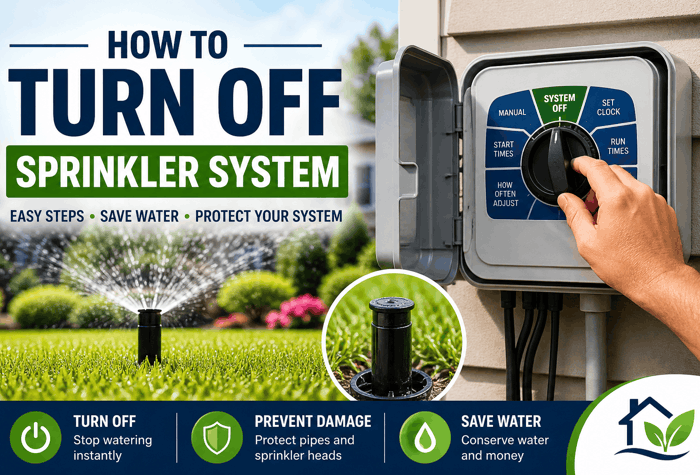


A sprinkler system blowout is the fall step that clears water from underground pipes, valves, and sprinkler heads with regulated compressed air before the first freeze. To blowout a sprinkler system, air runs through one zone at a time until only mist leaves the heads.
Key takeaways
- Blowout air pressure tops out at 80 pounds per square inch (psi) in rigid white PVC pipe and 50 psi in flexible black polyethylene pipe, per Hunter Industries.
- Pressure vacuum breaker and reduced pressure devices must never be blown out with compressed air, because the seals can melt. These backflow devices sit between irrigation piping and household water.
- Required airflow equals the largest zone’s gallons per minute divided by 7.5, in cubic feet per minute. A round example: 30 gallons per minute needs 4 cubic feet per minute.
How do you blow out a sprinkler system?
To blow out a sprinkler system, shut off the water and attach an air compressor to a connection point after the backflow device. Then run air through one zone at a time, furthest first, until only a fine mist leaves the heads.
- Put on ANSI-approved safety eye protection, and stay clear of pipes, sprinkler heads, and valves while they hold air.
- Shut off the irrigation water supply.
- Attach the compressor hose to the connection point after the backflow device, with the compressor valve closed.
- Close the isolation valves on the backflow device.
- Set the compressor regulator to 50 psi or lower, and below the rating of the lowest-rated part in the zone.
- Activate the zone highest in elevation and furthest from the compressor, so one control valve is open before air starts.
- Slowly open the compressor valve until the sprinkler heads pop up.
- Run the zone for no more than two minutes, stopping sooner once only a fine mist leaves the heads.
- Advance the controller to the next zone, working toward the closest one, and leave the controller on until the compressor is off.
- Repeat the full pass so every zone gets two or three short cycles.
- With the last zone still running, shut off the compressor, unhook the hose, and release the remaining air.
Rain Bird caps one cycle at two minutes. Hunter Industries calls for two or three short cycles per zone, stopping once no water is visible. A zone still wet at two minutes therefore gets another short cycle, not a longer one.
Colorado State University Extension does not recommend relying on drain valves alone, because buried pipe shifts over time and cannot be inspected. Systems with electric valves need compressed air to clear water from the valve diaphragm (the rubber membrane inside the valve).
When should you blow out a sprinkler system?
Blow out a sprinkler system before the first freeze of fall. That date can arrive as early as late summer in the coldest northern and mountain areas, and not until December in the warmest southern areas.
Hunter Industries describes the blowout as a priority where frost reaches below the depth of the buried piping.
The NOAA National Centers for Environmental Information defines a first freeze as widespread air temperatures of 32°F or below that last long enough to matter climatologically, using 1991–2020 climate normals.
| Region | Median first-freeze window (NOAA National Centers for Environmental Information) |
|---|---|
| Northwest | Early September to November |
| Northern Arizona, Nevada, Utah, Colorado, New Mexico | September to November |
| Most of California and southern Arizona, outside high elevations | December at the earliest |
| Midwest | Mid-September to early October |
| Northeast | Mid-September to early October, or early September farther north |
| South | Early October in Virginia, to December farther south |
| Hawaii | Only the highest elevations freeze |
| Alaska | Varies widely across the state |
| US territories | Not covered by NOAA’s regional summary |
The median map shows each area’s date. Waiting until then means a freeze has already arrived in half of all years. The earliest-10-percent map is the safer deadline, since a freeze comes before that date only one year in ten.
Elevation, latitude, and urban or shoreline settings shift each location, and the National Weather Service issues frost and freeze watches and warnings.
What should you check before blowing out a sprinkler system?
Before blowing out a sprinkler system, confirm the pipe material, find the water shutoff, and identify the backflow device type. Then locate the connection point after that device, note the largest zone’s gallons per minute, and remove any flow sensors.
- System type: Hunter Industries recommends the blowout method when the system type is unknown. Systems built for manual draining are covered in how to winterize sprinkler system without blowout, but Colorado State University Extension does not recommend relying on drain valves alone.
- Pipe material: Hunter Industries describes rigid white pipe as PVC and flexible black pipe as polyethylene.
- Water shutoff: The stop and waste valve (a shutoff with a drain) sits before the backflow device and can be about 5 feet down. Colorado State University Extension says it may need a long key and should not be forced.
- Backflow device: Identify whether it is a pressure vacuum breaker, a reduced pressure device, or an atmospheric vacuum breaker, since each is handled differently.
- Largest zone flow: Read gallons per minute from the plan or add nozzle ratings, per Colorado State University Extension.
- Flow sensors: Remove them and seal the pipe before any air goes in, per Hunter Industries.
What do you need to blow out a sprinkler system?
The equipment for a sprinkler blowout is an air compressor with a pressure regulator, a hose, and a connection point after the backflow device. Safety eye protection is also essential, and Hunter Industries notes compressors can be rented.
Colorado State University Extension calls for a pressure regulator on the compressor outlet and notes that a metal fitting, not PVC, on the airline helps dissipate heat. Rain Bird’s procedure attaches the hose to a blow-out adapter.
A blowout fitting is a tee with a threaded plug installed so a compressor hose can attach to the pipe. Colorado State University Extension shows them on either side of a reduced pressure device.
Hunter Industries lists a quick coupler or hose bib (an outdoor faucet connection) as other options, all located after the backflow device.
Neither source lists a separate blowout port or blowout valve. Both describe a connection point after the backflow device.
How much PSI do you need to blow out a sprinkler system?
Compressed air for a sprinkler blowout should stay at or below eighty pounds per square inch in rigid white pipe and fifty in flexible black pipe. Rain Bird sets its compressor regulator at fifty, and the lowest-rated part in the zone sets the real limit.
| Pipe | Maximum pressure | Source |
|---|---|---|
| Rigid white PVC | 80 psi | Colorado State University Extension and Hunter Industries |
| Flexible black polyethylene | 50 psi | Colorado State University Extension and Hunter Industries |
| Unknown pipe | 50 psi, the lower of the two limits | Colorado State University Extension and Hunter Industries |
| Any pipe, Rain Bird procedure | Regulator set to 50 psi | Rain Bird |
Colorado State University Extension lists 40 to 80 psi as the ideal compressor range and warns that pressure above a nozzle’s rating blows it off. Hunter Industries ties the limit to the lowest-rated component in the zone.
Rain Bird warns that long air runs through gear-drive rotors (sprinklers with an internal gear) can melt the head.
How much CFM do you need, and can a small compressor do it?
Airflow for a sprinkler blowout is sized from the largest zone. Divide that zone’s gallons per minute by seven point five to get the cubic feet per minute the compressor must deliver at the connection.
Pressure sets the ceiling, but volume decides whether the air clears the zone. Colorado State University Extension states that air volume is as critical as air pressure, because air rides over the water when volume runs short. Heads that stay up while air flows indicate the right size.
To size a compressor for a sprinkler blowout, divide the gallons per minute of the largest zone by 7.5 to get the cubic feet per minute required at the connection.
This calculation is a standard landscaping industry baseline used to properly size air compressors. As a round example, a zone flowing 30 gallons per minute needs 4 cubic feet per minute.
A smaller compressor can work when the airflow it delivers at the working pressure meets the zone’s figure.
Colorado State University Extension’s example pairs the two: a zone designed for 20 gallons per minute at 30 psi needs 2.66 cubic feet per minute at 30 psi. Colorado State University Extension also warns that undersized compressors take longer and work harder.
Hunter Industries warns against filling the tank and releasing it in one burst to make up for low airflow. Rain Bird instead recommends a large compressor sustaining 185 cubic feet per minute or more for best results.
The sources do not reconcile that gap, so the system manufacturer’s published figures take precedence.
Can you blow out a sprinkler system through the backflow preventer?
No. Compressed air should not be blown through a pressure vacuum breaker or a reduced pressure backflow device, because the heat can melt the rubber seals inside. The compressor connects to a fitting after the device.
Colorado State University Extension says pressure vacuum breaker and reduced pressure devices must never be blown out with compressed air.
Hunter Industries applies the rule to any backflow device. It also sets the order: blow out the system first, then drain the device or pump. During the blowout, the isolation valve on the downstream side stays closed.
Atmospheric vacuum breakers sit downstream of each valve, and Colorado State University Extension says compressed air clears them when the zone is blown out. They may be illegal in some areas. The local water district, building department, or county health department can confirm.
If the backflow device has no blowout fitting on its downstream side:
- Add a blowout fitting there first, because Colorado State University Extension says the system cannot be blown out without one.
- Do not push air through the device as a shortcut.
- Hire a qualified licensed contractor for the work, which Hunter Industries advises for winterization.
What should you do after blowing out a sprinkler system?
After blowing out a sprinkler system, disconnect the compressor, release the air pressure, and drain the backflow device and any pump. Then leave the backflow isolation valves about half open for winter, and keep the controller powered.
| Item | Winter action | Source |
|---|---|---|
| Compressor | Disconnect it and release the remaining air pressure | Hunter Industries |
| Backflow isolation valves | Open and close several times, then leave about half open (45°) | Colorado State University Extension and Hunter Industries |
| Test cocks (small valves on the side of the backflow device) | Leave open, then close before spring start-up | Hunter Industries and Colorado State University Extension |
| Pump | Drain it, then remove and store it inside, or wrap it for insulation | Colorado State University Extension |
| Controller | Keep the power on and do not unplug it | Colorado State University Extension and Hunter Industries |
| Valve boxes and backflow preventer | Insulate them | Rain Bird |
Both sources keep the controller powered but differ on programming. Hunter Industries leaves the dial at OFF so solenoids (the electromagnets that open valves) cannot activate. Colorado State University Extension suggests a weekly minimum cycle to keep plungers from sticking, so the manual should settle it.
Colorado State University Extension drains a reduced pressure device’s two check valves separately, removing the check cap, spring, and disk holder. Hunter Industries advises following the manufacturer’s recommendations for every component.
Conclusion
A sprinkler blowout works when regulated air moves through one zone at a time from a connection after the backflow device. Keep it at 50 psi or lower unless the pipe is confirmed PVC, and finish before the first freeze. Stop each cycle at two minutes or at a fine mist, and never push air through the backflow device itself.
FAQs
How long should each zone run during a sprinkler blowout?
Each zone should run for no more than two minutes per cycle during a sprinkler blowout, and for less time if only a fine mist leaves the heads sooner. Rain Bird caps a cycle at two minutes, and Colorado State University Extension advises stopping once the zone is dry.
Do you need to blow out a sprinkler system in a warm climate?
A sprinkler blowout is a priority where the frost level extends below the buried piping, according to Hunter Industries. That makes local frost depth, not the calendar, the deciding factor. The NOAA National Centers for Environmental Information reports no first freeze in most of California and southern Arizona until at least December, and none recorded in the Florida Keys.
Can a homeowner blow out a sprinkler system without hiring a professional?
Yes, a homeowner can blow out a sprinkler system with specialty equipment and careful attention to the instructions, according to Rain Bird. Rain Bird also advises a professional for anyone worried about doing something wrong. Hunter Industries recommends a qualified licensed contractor because compressed air can cause serious eye injury.
How much does a sprinkler blowout cost?
A professional sprinkler blowout costs different amounts depending on system size and local labor rates, so no single national figure applies. Quotes from local irrigation contractors give the most reliable price. Colorado State University Extension notes that fall preparation costs far less than spring repairs to damaged pipes, valves, and sprinklers.
Freeze timing, frost depth, and backflow rules vary by region and locality, and manufacturer manuals and local codes override this general guidance. A licensed irrigation contractor should handle compressed-air work or backflow device changes when any step is uncertain.