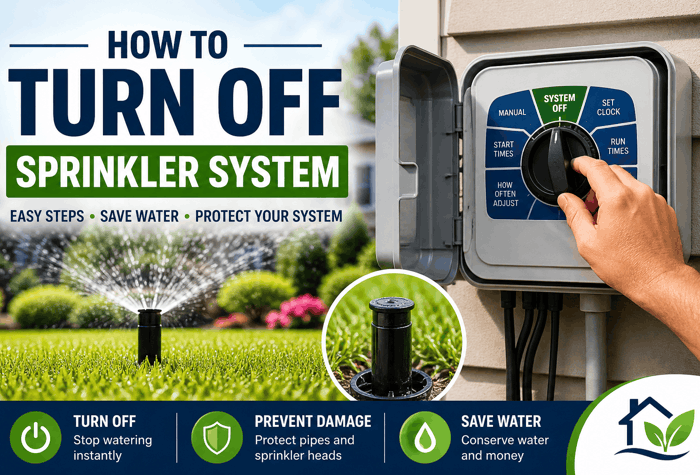


Winterizing a sprinkler system without a blowout is a freeze-protection method that drains irrigation pipes through manual or automatic drain valves instead of forcing water out with compressed air.
It is suitable only for systems with confirmed drain valves at the ends and low points of piping that slopes toward those valves, and only where remaining water is unlikely to reach freezing temperatures.
Key Takeaway
- Water expands about one-eleventh when it freezes at 32°F, enough to burst pipes and crack valves (Colorado State University Extension).
- Hunter Industries advises manual draining only where drain valves are confirmed at pipe ends and low points.
- A backflow preventer (the assembly that keeps irrigation water out of drinking water lines) needs its own draining, because frozen water can crack its brass body (Hunter Industries).
How to Winterize a Sprinkler System Without a Blowout
To winterize a sprinkler system without a blowout, confirm the system has drain valves and shut off the water. Then set the controller to Off or Rain mode, but leave it powered, open every drain valve, drain the backflow preventer, and insulate the parts above ground.
- Confirm the drain valves. Look for manual valves or automatic drains at the ends and low points of the piping. Manual draining does not confirm every buried pipe is empty.
- Colorado State University Extension notes that underground lines can shift and that compressed air is the only method that positively confirms enough water has been removed.
- Hunter Industries says this method suits only systems with confirmed drain valves; otherwise, follow the blowout decision rules below.
- Put on eye protection, which Colorado State University Extension lists as a caution for winterizing work.
- Shut off the irrigation water at the stop-and-waste valve (a shutoff with a drain port) or the isolation valve near the meter. Do not force a stuck valve. Colorado State University Extension notes that some sit five feet down and need a long key.
- Set the controller to Off or Rain mode, but leave it plugged in; this keeps the program and clock while allowing transformer heat to reduce condensation, according to Rain Bird and Colorado State University Extension.
- Slowly open each manual drain valve. Automatic drain valves open when system pressure drops. Hunter Industries says to activate a station to relieve system pressure so these valves can drain. For manual drain valves, first briefly activate a sprinkler zone to relieve pressure, then slowly open each valve. Close the manual valves again once the water stops draining.
- Drain the pipe between the shutoff and the backflow preventer. Open the boiler drain valve or the stop-and-waste valve’s drain cap, whichever the system uses (Hunter Industries).
- Pull up each sprinkler that has a check valve so water drains from the bottom of its body (Hunter Industries).
- Drain the backflow preventer according to its type: open the test cocks to release trapped water, and leave the isolation ball valves at about 45 degrees so water does not become trapped in the valves. A pressure vacuum breaker and a reduced pressure assembly require different draining steps, so follow the device-specific procedure below.
- Insulate exposed pipe with foam tape or foam tubes, and wrap the main shutoff valve in foam tape and a plastic bag (Rain Bird). Leave the air vents and drain outlets on backflow preventers uncovered.
Some water can remain after draining. Hunter Industries notes that, depending on where the drain valves sit, water may be left in the backflow preventer, the piping, and the sprinklers.
Rain Bird recommends contacting a local irrigation specialist because drainage work can involve safety risks. Hunter Industries recommends a qualified licensed contractor for compressed-air blowouts.
Are Sprinkler Blowouts Necessary?
Sprinkler blowouts are necessary where frost can reach the buried pipes, where the system cannot drain fully on its own, or where electric zone valves prevent gravity drainage. The decision depends on climate, valve type, and whether the pipes slope toward the drain valves.
Colorado State University Extension does not recommend relying on drain valves. Underground pipes shift over time, and the lines cannot be inspected after draining.
| Situation | What the source says | Source |
|---|---|---|
| Drain valves confirmed at pipe ends and low points | Hunter supports it with confirmed drain valves; CSU advises against relying on them | Hunter Industries |
| System type unknown | Use the blowout method | Hunter Industries |
| Pipes with humps or low spots | Gravity draining needs pipe laid to grade with no humps that trap water | Colorado State University Extension |
| Light to mild freezing in most of Texas | Turn off the controller and irrigation supply, insulate exposed PVC, and drain above-ground components such as the backflow assembly. | Texas A&M School of Irrigation |
Electric zone valves require extra caution. Colorado State University Extension says systems with electric valves must be blown out, because nothing else drains the water above the valve diaphragm. The manual-drain steps from Hunter Industries do not mention valve diaphragms.
A system of unknown design, or one where drain valves cannot be confirmed, should be evaluated by a qualified irrigation professional.
Hunter Industries directs readers to the blowout method in that situation, and Colorado State University Extension notes that compressed air is the only method that positively confirms sufficient water removal.
For readers who determine that a blowout is required, this safe DIY sprinkler blowout guide explains compressor limits, zone-by-zone procedure, and backflow precautions.
Compressed air can cause serious injuries, including eye injuries. Hunter Industries recommends a qualified licensed contractor for blowouts. Anyone using compressed air should not stand over pipes, sprinkler heads, valves, or other components while the system is pressurized.
Frost depth, the depth to which ground freezes, determines whether buried sprinkler pipes are at risk.
Hunter Industries gives blowouts priority where the frost level extends below the installed piping. Texas A&M School of Irrigation ties blowouts to northern states where ground freezes down to the pipelines.
How Is a Backflow Preventer Winterized?
To winterize a backflow preventer, shut off the water, open the test cocks, and turn both isolation ball valves to a forty-five degree angle so no water stays trapped. Drain the pipe leading to the device as well.
Hunter Industries notes that freezing water in a backflow preventer can damage its internal parts, and that the pressure vacuum breaker is the most common type. Colorado State University Extension describes three device types.
| Type | Where it sits | Winterizing point |
|---|---|---|
| Atmospheric vacuum breaker | Downstream of each zone valve | Drained when its zone is blown out |
| Pressure vacuum breaker | Above ground, with isolation ball valves and test cocks | Ball valves and test cocks are cycled several times, then left half open |
| Reduced pressure assembly | Above ground, with two check valves | Each check zone drains separately |
Compressed air must never be blown through a pressure vacuum breaker or reduced pressure assembly. Colorado State University Extension warns that the heat of the air can melt the rubber seals inside.
Hunter Industries gives the same order of work: blow out the system first, then drain the backflow preventer.
For a testable device, Salt Lake City Public Utilities’ winterization guidance lists the steps below; the manufacturer’s manual governs wherever it differs.
- Shut off the water to the irrigation system at the main valve or stop-and-waste valve.
- Open the test cocks by turning each screw a quarter turn.
- Turn the isolation ball valves on both sides of the device to a 45-degree angle, so they are neither fully open nor fully closed.
- Confirm that the pipe between the main shutoff and the device has drained.
- If the device was installed with unions, optionally remove it, drain both sides, open its test cocks, close its valves a quarter turn, and store it indoors.
- Insulate any device left outdoors, keeping its air vents and drain outlets uncovered.
A reduced pressure assembly adds steps, according to Colorado State University Extension. Open test cocks number two and number three to drain the water between the two check valves.
Then remove the check cap, spring, and disk holder on the second check, let it drain, and replace the parts. Local rules shape backflow requirements.
Atmospheric vacuum breakers may not be legal everywhere, so Colorado State University Extension advises asking the water district, building department, or county health department. Testing rules differ too.
The Salt Lake City Department of Public Utilities says backflow prevention assemblies must be tested annually under state plumbing and drinking-water rules, with results submitted to the water supplier.
When Should a Sprinkler System Be Winterized?
A sprinkler system should be winterized before the first fall freeze, when overnight temperatures are expected to reach 32°F or lower. That date falls between mid-September and early October in the Midwest and moves toward December farther south.
No single month applies nationwide. The NOAA National Centers for Environmental Information maps the median first fall freeze using 1991–2020 U.S. Climate Normals. The median works as a planning average rather than a guarantee.
| Region | First fall freeze |
|---|---|
| Midwest | Generally mid-September to early October. |
| Virginia | Early October. |
| Farther south | Later, moving toward December. |
| Parts of Florida | A freeze may not occur every year; the Florida Keys have no recorded freezing temperatures. |
| Alaska | Timing varies widely because of topography and northern location. |
| Hawaii | Only the highest elevations experience freezing temperatures. |
The NOAA National Centers for Environmental Information also publishes station-level freeze tables. The National Weather Service office in Aberdeen, South Dakota, defines a freeze watch as conditions favorable for temperatures below 32°F within 12 to 48 hours.
A freeze warning means high confidence of temperatures below 32°F within 24 hours.
What Else Needs Winterizing Besides the Pipes?
Besides the pipes, a sprinkler system needs its pump, pump wiring, sensors, and controller prepared for winter. A pump is drained and stored indoors, and a rain sensor with a cup is emptied and covered.
- Pump: Colorado State University Extension says to drain the pump, remove it from the system, and store it indoors; where removal is not possible, drain it and wrap it for insulation.
- Pump-start wiring: where the controller starts a pump, Rain Bird says to disconnect the master valve and common wires.
- Rain sensor: for a type with a cup that catches water, Hunter Industries says to empty the cup and cover the sensor with a plastic bag.
- Flow sensor: Hunter Industries says flow sensors can be damaged by blowout techniques and should be removed before compressed air is injected into the pipes.
Controller power guidance differs between sources. Hunter Industries says to leave dial-type controllers powered with the dial off, because transformer heat prevents condensation.
Colorado State University Extension also says not to unplug the controller, while Rain Bird accepts powering off at the cost of reprogramming in spring.
Summary
Confirm the drain valves before opening any part of the system. With confirmed drain valves, draining, a drained backflow preventer, and insulation protect the system before the first fall freeze. Where drain valves cannot be confirmed, Hunter Industries points to the blowout method, performed by a licensed contractor.
FAQs
Will a sprinkler system freeze at 28 degrees?
Yes. Water freezes at 32°F, so water left in pipes, valves, or backflow devices can freeze at 28°F. NC State Extension defines a hard freeze as temperatures below 28°F. Whether buried pipe freezes depends on whether frost reaches its depth.
Why do sprinkler systems need winterizing?
Leftover water expands by about one-eleventh as it freezes. That force can crack pipes, fittings, valves, sprinkler bodies, and pumps, even after draining.
Does a winterized sprinkler system need periodic checks?
Yes. Colorado State University Extension recommends leaving the controller powered and running a minimum weekly cycle to help keep solenoid plungers from sticking. Inspect the system again at spring startup.
Can a sprinkler system without a backflow preventer be winterized?
Systems using household water require backflow protection. Atmospheric vacuum breakers, installed at each zone, are winterized when that zone is blown out with compressed air.
Freeze depth, local plumbing and backflow-testing rules, and each manufacturer’s manual take precedence over general guidance. A licensed irrigation or plumbing professional should handle blowouts and any backflow preventer that cannot be drained with confidence.